AI workforce transformation: lessons from 2011 and the challenges of 2025
There are striking similarities between AI-driven workforce transformation in 2025 and the governance of enterprise IT shifts I helped navigate in 2011, revealing why structured workforce planning, upskilling, and role evolution are more critical than ever.
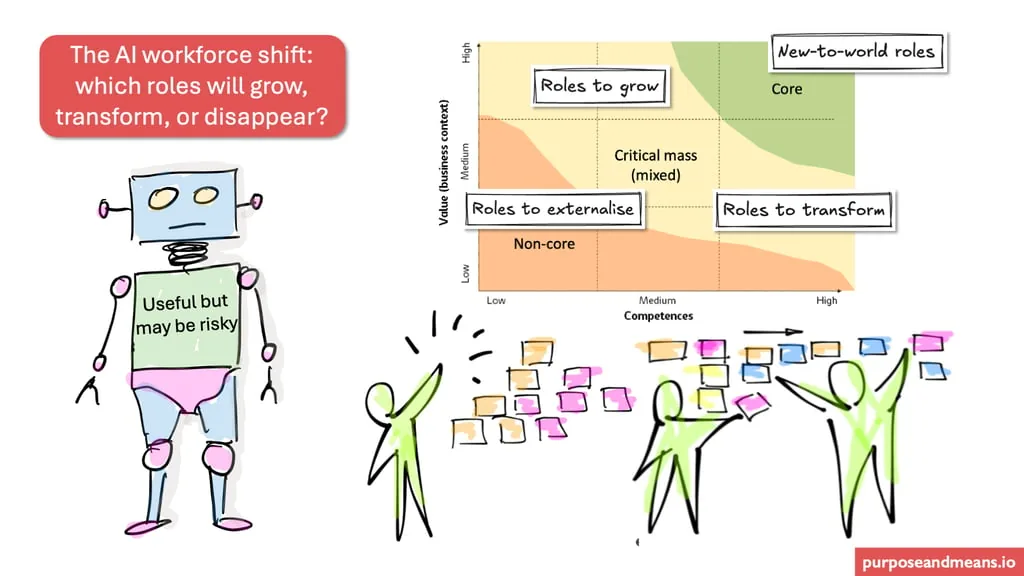
Back in 2011, I designed and facilitated workshops for the global IT division of a top 3 global FMCG company headquartered in Denmark. They knew that the future business strategy would require a shift in how IT goals aligned with business goals - one of the key mechanisms required for governance of enterprise IT - and from a organisational perspective much work was needed. Technology and operating models were shifting dramatically. New roles were emerging. Others were transforming. Some were diminishing, primed for outsourcing.
The exercise was blunt but necessary: resource managers had to categorise their teams into four groups:
New-to-world roles – brand new functions that didn’t exist before
Roles to grow – critical skills that needed investment
Roles to transform – requiring upskilling or lateral movement
Roles to externalise – those likely to be outsourced or phased out
A tough and uncomfortable process, but an inevitable one, and these days I see the company still dominating various markets globally.
Now, in 2025, I see the exact same conversation unfolding, but this time, AI is the catalyst.
AI: the new workforce disruptor #
A recent CSET report on AI and workforce training reveals some interesting numbers:
80% of US workers will have at least 10% of their tasks impacted by AI
19% of jobs could see over half their tasks affected
That’s not ‘some people, some of the time.’ That’s nearly everyone, in every role, across every industry.
But what I found really surprising is that the most in-demand skills in the AI age aren’t even technical.
According to the CSET Report, 58% of critical future skills are social, cognitive, and foundational, things like:
Complex problem-solving
Active learning
Adaptability
Ethical judgment
This isn’t just about coding, data science, or AI engineering, it’s about learning how to work alongside AI, not be replaced by it.
AI literacy: the new corporate imperative #
The EU’s AI Act explicitly calls for AI literacy training in organisations providing or deploying AI, and the European AI Office’s ‘Living Repository of AI Literacy Practices’ published recently is a good read if you’re seeking inspiration.
Companies like Booking.com, Assicurazioni Generali, and Telefónica have already launched AI upskilling programmes to prepare their teams.
For example, Generali’s ‘New Roles Schools’ focus on:
Creating new AI-related roles (e.g., AI Business Translators, Smart Automation Experts)
Reskilling actuaries, accountants, and CRM professionals with AI capabilities
Providing tiered AI training, from basic literacy to advanced engineering
In a similar vein, OpenSky Data Systems is training both technical and non-technical staff, teaching developers how to integrate AI into software, while helping non-technical teams leverage AI tools in decision-making.
This mirrors the very structure of my 2011 workshops: identifying which roles need to evolve, transform, or disappear, only this time, AI is driving the change.
How companies should approach AI workforce planning #
Companies need a proven, structured approach to AI-driven workforce transformation.
That’s exactly why my AI Workforce Adaptation Workshop, built on my 2011 framework, is now available.
If your company is facing AI-driven workforce shifts, the questions you need to be asking are:
Which roles will AI create?
Which roles need to evolve?
Which roles will disappear?
How do we prepare people for the transition?
These are not questions for the legal team. In these workshops, legal are a participant, along with a wide range of representatives from across the company. Like must GRC endeavours, it’s a collaborative effort.
The companies getting this right are those that see AI as an augmentation tool, not just a replacement tool.
How is your company preparing for the AI workforce transition?
Does this resonate? If so, get in touch to arrange a no obligation discussion.