
Your data protection programme ticks the compliance boxes. So why does leadership still treat it as a cost centre? Why do business functions see it as a blocker rather than an enabler? And why does so little actually change after each annual review?
The answer is usually the same: the programme was built to satisfy regulators, not to serve the business. It speaks the language of legal obligations rather than business outcomes — and that disconnect costs you funding, buy-in, and influence.
A data protection strategy aligned with business purpose changes that.
It connects your data protection work to the things leadership already cares about — customer trust, digital marketing execution, AI readiness, and sustainable growth. It shifts the perception of your role from necessary evil to growth enabler. And it gives you the mandate and stakeholder support to actually get things done.
What we deliver #
We work with data protection leaders to build a strategy that is grounded in your company’s business reality — not a generic framework lifted from a textbook.
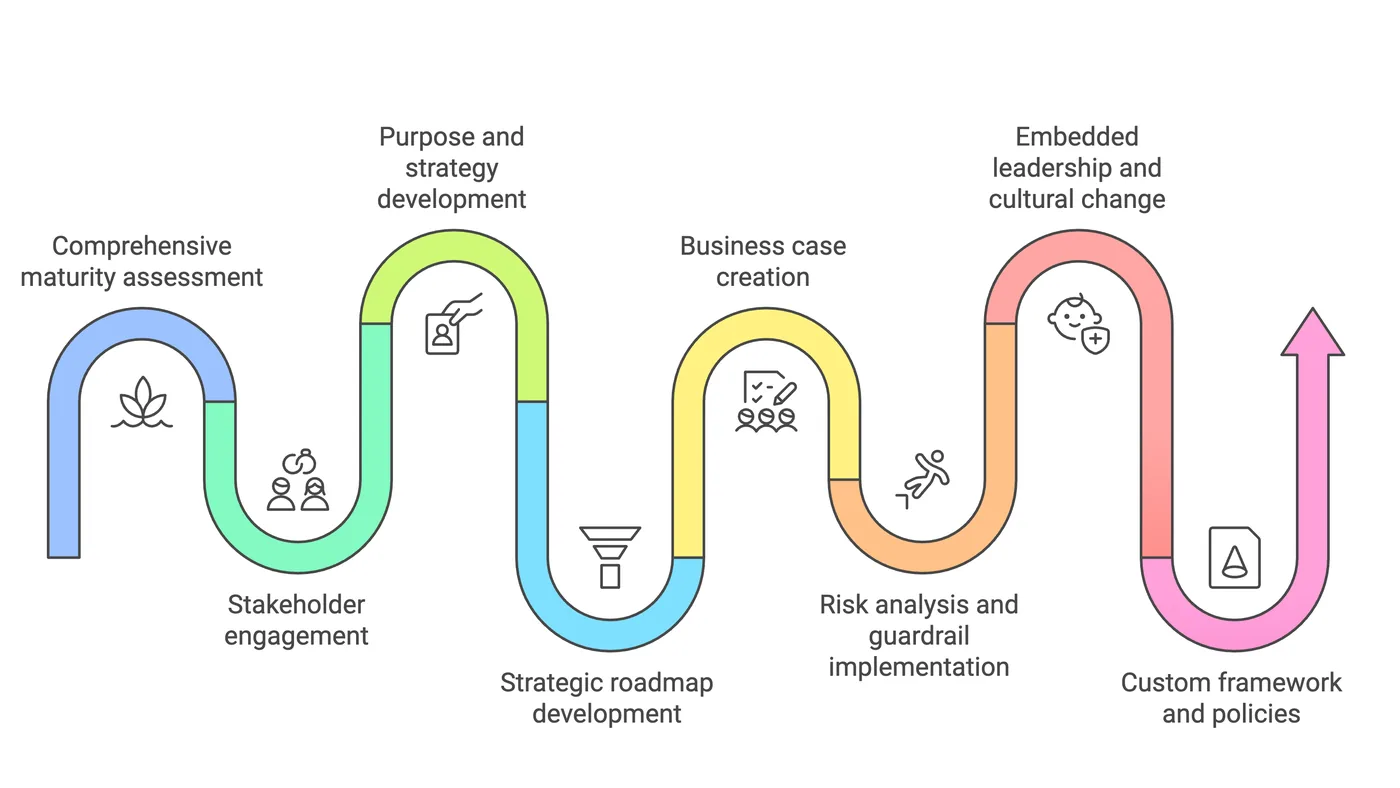
Gap analysis and maturity assessment. We evaluate where your programme stands today against what your business actually needs — not just what the regulation requires.
Business alignment. We map your data protection work to the data-driven elements of your company’s business strategy, identifying where data protection enables (rather than blocks) growth, innovation, and competitive advantage.
Stakeholder engagement. We help you communicate with senior management, digital marketing, HR, IT, and other functions in their language — building shared ownership rather than isolated compliance.
Practical roadmap. We develop a prioritised, step-by-step plan with clear work packages, deliverables, milestones, and outcomes that leadership can understand and fund.
Meaningful reporting. We design reporting mechanisms that align data protection metrics with business value — so your board sees impact, not just activity.
What makes this approach different #
Purpose before policy. We start by defining a clear data protection purpose that resonates across the company — a compelling “why” that employees and leadership can rally around.
Beyond the legal lens. Data protection is not just a legal issue. We bring business analysis, change management, and employee engagement skills that most law firms don’t offer.
Built to last. We design programmes that integrate into daily operations — effective policies, tailored procedures, and governance structures that work in practice, not just on paper.
Future-ready. We incorporate horizon scanning and foresight so your strategy accounts for emerging technologies like AI, evolving regulations, and ESG alignment.
Who this is for #
This approach works for data protection leaders, DPOs, privacy officers, CISOs, and senior management in companies where data protection needs to move beyond a compliance checkbox. The same framework applies equally to AI governance, information security, and ESG programmes.
Let’s get started #
If your data protection programme has the policies but lacks the strategic alignment, stakeholder buy-in, and business mandate to make real progress — book a call to discuss your situation. No obligation, no sales pitch — just a practical conversation about what needs to change.
Frequently Asked Questions #
What is a data protection strategy and why does my company need one? #
A data protection strategy is a roadmap that aligns your data protection programme with your company’s business objectives. Without one, data protection remains an isolated compliance function — reactive, underfunded, and disconnected from the business decisions that actually involve personal data. A strategy gives you the mandate, the stakeholder buy-in, and the prioritised plan to move from ticking boxes to driving real change.
How is this different from what a law firm would provide? #
Law firms typically approach data protection through a legal lens — articles, recitals, interpretation, and case law. That work is essential, but it’s not sufficient. We complement legal teams by bringing business analysis, stakeholder engagement, visual communication, and change management skills. The goal is a programme that works operationally, not just legally.
How long does it take to develop a data protection strategy? #
It depends on your company’s size and complexity, but a typical engagement runs 8–12 weeks from initial assessment through to a finalised roadmap. We can also work in shorter sprints focused on specific elements — for example, a standalone maturity assessment or stakeholder alignment workshop.
Can this approach be applied beyond data protection? #
Yes. The same framework — purpose definition, maturity assessment, business alignment, stakeholder engagement, and roadmap development — applies to AI governance, information security, ESG programmes, and other disciplines where compliance alone doesn’t drive the behaviour change you need.