Field Talk: fourteen speakers confirmed, three months to go
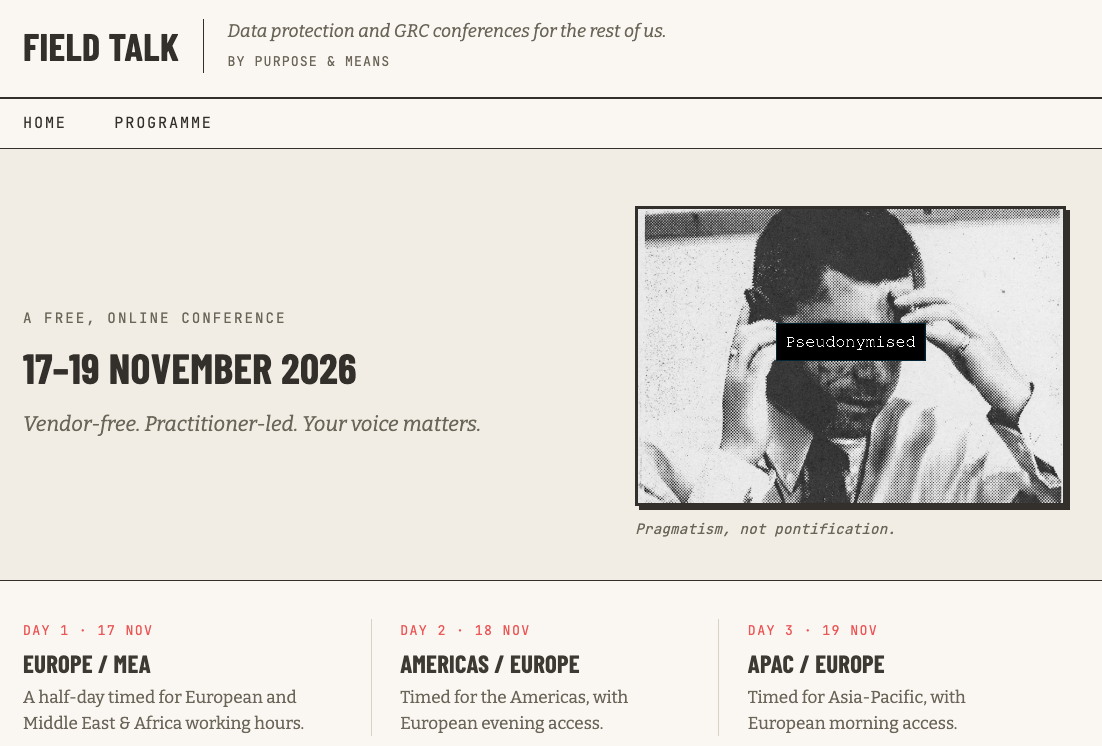
Field Talk 2026 is only 3 months away. 14 of 15 speakers are now confirmed and the programme is live at fieldtalk.eu. Attendance is free.
Where things stand #
The conference runs 17–19 November 2026. Three half-days. Three time zones. Each session is 30 minutes of practitioner experience, followed by 10-15 minutes of questions.
14 speakers have confirmed their slots. The 15th is close. The programme page is being updated as each session is locked in. You can see it now at fieldtalk.eu/programme.
Why Field Talk exists #
I think the mainstream data protection conference circuit has had its day. Excess and elitism, and it’s out of reach for many practitioners. I think the larger events are too legal-oriented without representation from the professionals who are responsible for the actual processing and protection of data.
The large events cost thousands of euros to attend. Add flights and accommodation and you are looking at a week’s consultancy fees for a sole practitioner — or a line item that simply does not exist in a small company’s budget. Many of the people doing the most important data protection work in Europe are not in those rooms. They cannot afford to be.
That is before you get to the programme itself. A significant portion of the speaking slots at large conferences are shaped by sponsorship. The tool vendors, the law firms, the BigTech compliance teams — they are not there because they have the most useful things to say. They are there because they paid to be there through corporate membership.
The result is a circuit that serves the industry rather than the profession. It is useful for networking if you can afford the ticket. It is less useful if you are a DPO navigating real problems on a shoestring, or a consultant advising controllers who have never had a proper programme.
What the grassroots looks like #
There is a huge amount of data protection work that happens in companies with no dedicated budget for practitioner development. The DPO is doing three other jobs. The consultant is working alone. The privacy lead inherited the role from someone who left.
These are the people who most need access to honest, practical, peer experience. They are the last people who can spend a couple of thousand euros on a conference ticket.
Field Talk is built for them. Deliberately. The conference is free to attend. It is online, so there are no flights and no hotels. The sessions run across three time zones so you can attend from wherever you are without losing your whole working week.
The speakers are practitioners. People who have built programmes from nothing, handled incidents without a playbook, and worked out the hard way what does and does not work. That is the content that is useful. That is the content that is missing from the expensive events.
What I mean by vendor-free #
Field Talk has no sponsors. No company has paid for a session. No product is being pitched. Every speaker was selected because they have something worth saying, not because their employer bought a slot.
This is not just an ethical position. It changes the programme. When there is no sponsor to protect, speakers can say what they actually think, with candor.
The conference runs on self-hosted European infrastructure. No BigTech cloud, no tracking, no third-party scripts. The site is clean.
Stay informed — the newsletter #
The Purpose and Means newsletter goes out for the first time at the end of next week. It will carry practical data protection and GRC content, alongside updates on Field Talk as the November dates approach.
The signup form is on the Field Talk website — it takes about 30 seconds. You choose whether to give your name. You get a confirmation email. After that, you will hear from us when there is something worth saying.
Field Talk beyond 2026 #
November is the first event. It will not be the last. The next Field Talk is planned for early 2027, and the intention is to keep running these on a regular basis for as long as practitioners want them.
If you want to speak at a future event — not just November, but 2027 and beyond — register your interest on the Field Talk website. First-time speakers are welcome. The main requirement is having done the work and having something honest to say about it.
Come and join us #
If you work in data protection, privacy, GRC, or AI governance, Field Talk is for you. Free to attend. No registration wall. Just turn up.
Details at fieldtalk.eu.
Frequently Asked Questions #
What is Field Talk? Field Talk is a free, online conference for data protection, privacy, GRC and AI governance practitioners. It runs 17–19 November 2026 across three half-days, each timed for a different region. There are no sponsors, no ticket price, and no vendor sessions.
Who is Field Talk for? Anyone doing data protection or GRC work. The programme is designed for practitioners — people building and running programmes, advising controllers, or working through real compliance problems. It is particularly useful for people who cannot access or cannot afford the mainstream conference circuit.
How do I attend? Registration is free. Go to fieldtalk.eu and sign up for updates. Sessions will be streamed live and recordings will stay free afterwards.
Will there be future Field Talk events? Yes. The next event is planned for early 2027. If you want to speak at a future event, register your interest on the website.