History and Origins of Employee Monitoring
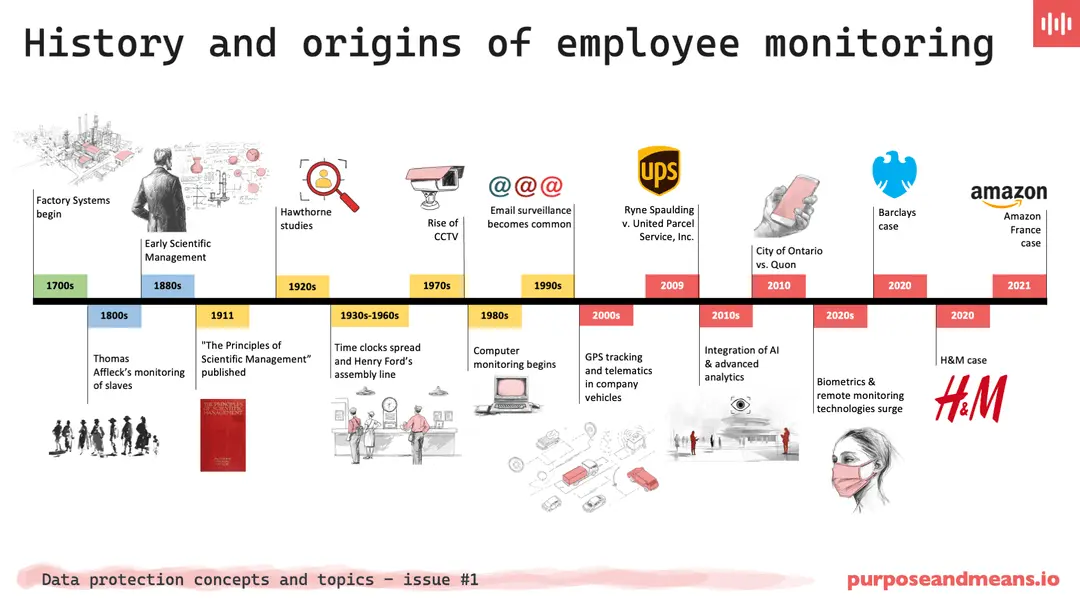
Employee monitoring is a hot topic and during the pandemic we saw this contentious issue, and its associated technologies, entering employees’ homes. To understand what’s happening today, we must step back and trace the origins and evolution of employee monitoring over past centuries.
As you can see from the timeline, in the early days the focus was primarily on efficiency and productivity, influenced by Frederick Taylor’s principles of scientific management. This era saw the introduction of time clocks and later, the use of observation and checklists to measure employee performance.
In the mid-20th century, the development of surveillance technologies saw a shift towards more sophisticated monitoring with the advent of video surveillance and computer monitoring in the latter half of the century. Technology evolved rapidly at the turn of the 21st century that accelerated employee monitoring practices with the introduction of software to track digital activities, GPS for location tracking, and eventually, advanced analytics and AI in the modern workplace.
Here are brief descriptions of the milestones on the timeline:
Late 1700s: Factory Systems begin The onset of the Industrial Revolution introduces the factory system, where structured oversight of workers is necessary to manage and synchronise labour with mechanical processes. This period marks the beginning of formal workplace supervision.
Mid-1800s: Thomas Affleck’s monitoring of slaves Agriculturalist Thomas Affleck publishes “Plantation Record and Account Book,” which provides detailed frameworks for monitoring enslaved workers on Southern plantations. The guide includes meticulous record-keeping techniques aimed at maximising agricultural output and labour efficiency under harsh conditions.
1880s: Early Scientific Management Frederick Taylor begins developing his management theories that would lay the foundation for scientific management. His early observations and experiments focus on optimising manual labour tasks and workflows, which he would later formalise.
1911: Frederick Taylor publishes “The Principles of Scientific Management” Taylor formalises his theories in a seminal publication that argues for the efficiency of workers being maximised through scientific analysis of labour processes. His work introduces time studies, standardisation, and systematic planning as methods to enhance productivity and control.
1924-1932: Hawthorne studies Conducted at Western Electric’s Hawthorne Works in Cicero, Illinois, these studies initially aimed to examine how physical conditions, such as lighting and work hours, affected worker productivity. Surprisingly, researchers found that attention to employees significantly influenced their performance—a phenomenon dubbed the “Hawthorne effect.”
1930s-1960s: Time clocks spread and Henry Ford’s assembly line The proliferation of mechanical time clocks allows for more precise tracking of employee attendance and hours worked. Simultaneously, Henry Ford revolutionises manufacturing with the assembly line, which standardises production and incorporates monitoring at every stage to ensure efficiency.
1970s: Rise of CCTV The adoption of Closed-Circuit Television (CCTV) in workplaces marks a significant advancement in surveillance technology, extending beyond security to include monitoring employee behaviour and performance.
1980s: Computer monitoring begins The widespread introduction of personal computers in workplaces leads to new forms of electronic monitoring. Employers begin using software to monitor computer usage, including application and email surveillance.
1990s: Email surveillance becomes common As email becomes an essential tool for corporate communication, companies increasingly monitor email traffic to safeguard proprietary information and ensure compliance with company policies.
2000s: GPS tracking and telematics in company vehicles The adoption of GPS tracking devices and telematics technology in company vehicles allows employers to monitor routes, driving habits, and operational efficiency, enhancing fleet management and worker safety.
Ryne Spaulding v. United Parcel Service, Inc. (2009) This case highlights the debate over GPS monitoring in company vehicles, with the court upholding the employer’s right to use GPS for business efficiency and safety monitoring.
2010s: Integration of AI and advanced analytics Businesses start leveraging artificial intelligence and sophisticated analytics to monitor employee productivity, behaviour, and predict future workforce needs and outcomes.
City of Ontario vs. Quon (2010) This landmark legal case addresses the extent of workplace privacy, with the US Supreme Court ruling that the city’s review of text messages on a police officer’s city-issued pager was reasonable and did not violate the Fourth Amendment.
2020s: Biometrics and remote monitoring technologies surge The use of biometric data for monitoring purposes, such as fingerprint scanning and facial recognition for access control and timekeeping, becomes more prevalent. The COVID-19 pandemic also accelerates the adoption of remote monitoring tools, including software to oversee employees working from home.
Barclays and H&M cases (2020) These cases illustrate the potential pitfalls of invasive monitoring practices. Barclays retracts an employee monitoring system after backlash, and H&M faces a hefty fine for processing personal data without adequate transparency to their employees among other things.
Amazon France case (2021) Amazon is fined by the CNIL for excessive surveillance of warehouse workers, sparking significant debate over privacy and surveillance in the workplace.
Frequently Asked Questions #
When did employee monitoring begin? Structured employee monitoring dates back to the late 1700s with the introduction of the factory system during the Industrial Revolution. Formal workplace supervision became necessary to synchronise human labour with mechanical processes. Frederick Taylor formalised the principles of scientific management in 1911, introducing time studies and standardised workflows to maximise efficiency.
Is employee monitoring legal under the GDPR? Employee monitoring is not prohibited under the GDPR, but it must comply with the regulation’s principles. Employers need a lawful basis under Article 6 (often legitimate interests), must conduct a Data Protection Impact Assessment under Article 35 where monitoring is likely to result in a high risk to employees, and must provide clear and transparent information to employees under Articles 13 and 14. Several enforcement actions — including CNIL’s fine against Amazon France in 2021 and Hamburg DPA’s fine against H&M in 2020 — demonstrate that excessive or non-transparent monitoring attracts significant penalties.
What are the main data protection risks of employee monitoring? Key risks include processing excessive amounts of personal data (violating the data minimisation principle under Article 5(1)(c)), lack of transparency about what is being monitored and why, inadequate legal basis for the processing, disproportionate surveillance relative to the stated purpose, and failure to conduct a DPIA before deploying monitoring technologies. These risks apply equally to on-site and remote monitoring.
Purpose and Means is a niche data protection and GRC consultancy based in Copenhagen and operating globally. We work with companies providing services with flexibility and a slightly different approach to the larger consultancies. We have the agility to adjust and change as your plans change. Take a look at some of our client cases to get a sense of what we do.
We are experienced in working with data protection leaders and their teams in addressing troubled projects, programmes and functions. Feel free to book a call if you wish to hear more about how we can help.