How to build a Future Radar that actually works
I’ve been designing and facilitating workshops, and practicing business analysis for decades. After developing a radar covering the future of this field, a few things stood out prompting me to update my personal development plan for 2026.
Why your foresight needs structure
When some people view a trends radar, they see a collection of interesting ideas, perhaps one or two things will stand out. A truly effective radar, like ones powered by FIBRES isn’t just a colourful diagram. It’s a structured sensemaking system. Every individual dot, every connection, every link serves one purpose: to trace the journey from a raw piece of evidence to actionable strategic foresight.
In addition to the ‘Horizon Scanning for Beginners’ blog series I published a few months ago, I want to take a deeper look at some key terms and concepts which in reality are the essential building blocks and describe how they really connect. I’m talking Signals, Signal Clusters, Technologies, Trends, and Megatrends. And to prove it’s not just theory, I’ll share a radar I made last week and explain how I deployed these concepts in mapping a topic that is close to my heart, the Future of Business Analysis and Workshop Facilitation.
The discipline I formalised 25 years ago
To give a bit of context, although I had been working for many years before this, ‘running’ meetings and workshops was always quite ad hoc for me, and it was only when I was thrust into an awkward position in a high-maturity major projects organisation did I realise that I had to up my game in this area. I took a dedicated workshop facilitation course that I think ranks among the best hands-on training course I’ve ever done. More on this later.
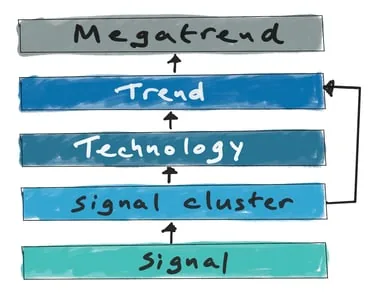
The foresight hierarchy
Let’s begin by looking the strategic flow as I work with it, because understanding the current is the first step to navigating it. As I say, it’s how I work with it, I’m sure many have different approaches and foresight purists may disagree.
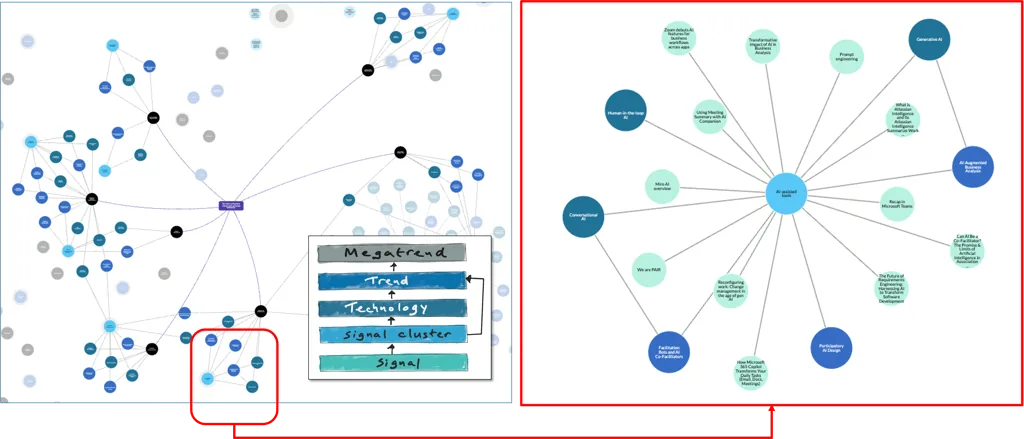
1. Signals
Signals are the concrete, observable manifestations happening right now. They are indicators of change: a product launch, a disruptive pilot project, a groundbreaking case study, a new regulation making headlines, or it could be early, academic findings. For** **example “Miro announces AI co-facilitator features for workshops (2025).”
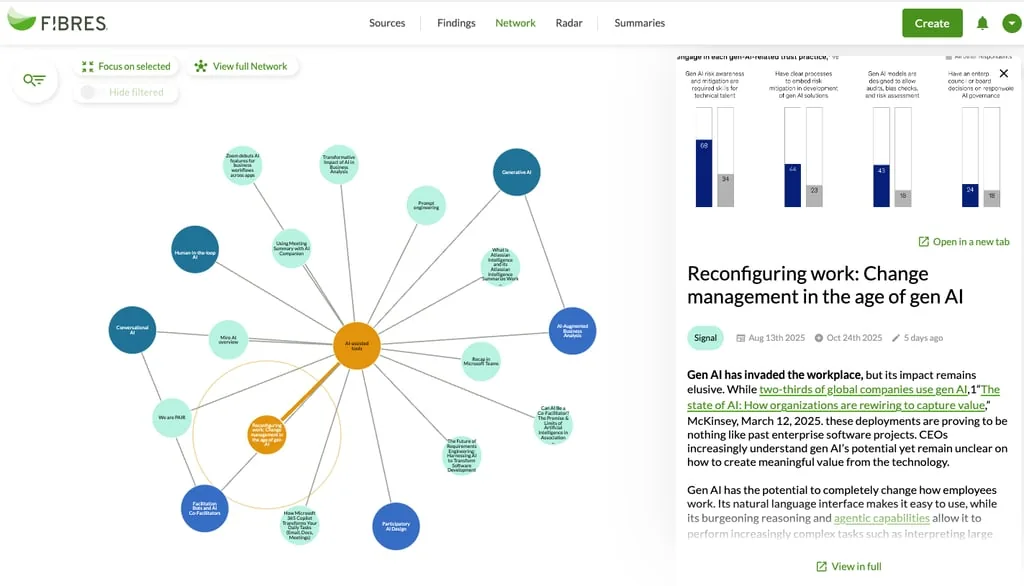
In FIBRES, each signal is a discrete data point, logged with its own link, verifiable source, and timestamp. It’s the evidence. A signal can be added from different types of content such as a web page, a document, an image, a podcast.
2. Signal clusters
When the disparate signals start to align, and point in the same direction, you’re not just seeing random events anymore. You’re observing a Signal Cluster – an emerging pattern. For example, “AI-assisted tools” (grouping potent signals like Miro AI, Excalidraw AI, Atlassian Intelligence).
Signal clusters transform raw noise to the clarity of pattern recognition.
3. Trends
Trends are the core of the radar. They represent the insights you must track, the narratives you need to communicate, and the shifts you must act upon. Each trend is supported by one or more signal clusters, often underpinned by enabling technologies and can be heavily linked to a broader megatrend. For example, AI-Augmented Business Analysis:
Linked to cluster: AI-assisted tools
Linked to technology: Generative AI
Linked to megatrend: Human–AI Collaboration
4. Technologies & Methods
Technologies are often the enablers that bind multiple trends together, so they aren’t just entries on the radar. They answer the fundamental question: *What makes this trend not just possible, but inevitable? For example, *“Generative AI” isn’t a trend in itself, it’s the tech enabling trends like AI-Augmented Business Analysis, Augmented Visual Facilitation, and Algorithmic Sensemaking.
By intentionally keeping technologies off the primary radar (but still within the FIBRES network), my radar maintains focus and there’s a network view that reveals the web of how these technologies underpin disparate trends. This is systems thinking in action.
5. Megatrends
At the top of the structure are Megatrends. These are long-term, system-level forces shaping everything else. They aren’t things you can directly “do”, but they provide the strategic context for trends. For example, Human–AI Collaboration, Playful & Ethical Organisations, Future-Ready Enterprises.
Megatrends give the radar coherence and a higher level narrative and context, connecting clusters of trends and telling a story about transformation.
How the links work together
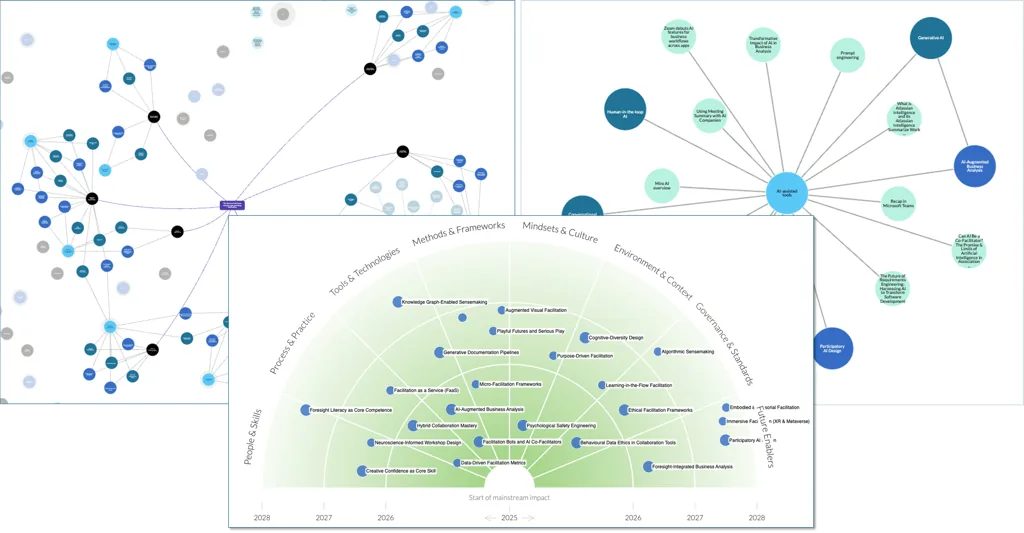
So how so these layers connect and work together? In Fibres, this is known as the Network view, and in my mind, it’s behind the scenes, showing the mechanics behind the radar. At first sight, it may appear slightly confusing, but once you begin to navigate around the network view you can begin to appreciate the interconnectedness of the structure. In the image below, the diagram on the left shows the overall view of the network for my topic The future of business analysis and workshop facilitation, and on the right, it’s the expanded view you can click to by selecting a signal cluster, will will then show the cascade of signals that drive the trend.
And then, once at that level you are able to get information about each signal, linking back to the original source (e.g. a web page, press release, etc.) and see all the linkage to other signals, signal clusters, technologies and trends. The image below shows one signal from the signal cluster AI-assisted tools:
My radar
In my own radar, I’ve mapped 25 trends across eight thematic sectors:
People and skills
Process and practice
Tools and technologies
Methods and frameworks
Mindsets and culture
Environment and context
Governance and standards
Future enablers
Each trend on the radar links back to relevant real-world signals such as:
Inclusive collaboration
Miro AI
Atlassian Intelligence
LEGO Serious Play
OECD Strategic Foresight Toolkit
I’m plotting the trends across four horizons: 2025, 2026, 2027 and 2028, but I could have easily have chosen now, next and beyond. Or from the perspective of adoption, ease of implementation, etc. Also, remember that I chose to plot trends only but I could also show megatrends, technologies, signal clusters and the signals themselves. A lot depends on your context and the objective of the radar. I prefer to keep this clear and simple, less is more.
I’ve also found choosing a narrow scope helps, instead of trying to map trends across a broad scope where things may get slightly diluted.
This structure allows me to explore not just what’s happening, but why it matters, and how it connects to wider transformation themes. This layered foresight approach helps:
Build evidence-based narratives instead of relying on intuition.
Spot early signals of change and link them to real impact areas.
Translate foresight into strategy, by aligning trends with technologies and megatrends.
Collaborate better, as everyone sees the same “map of meaning”.
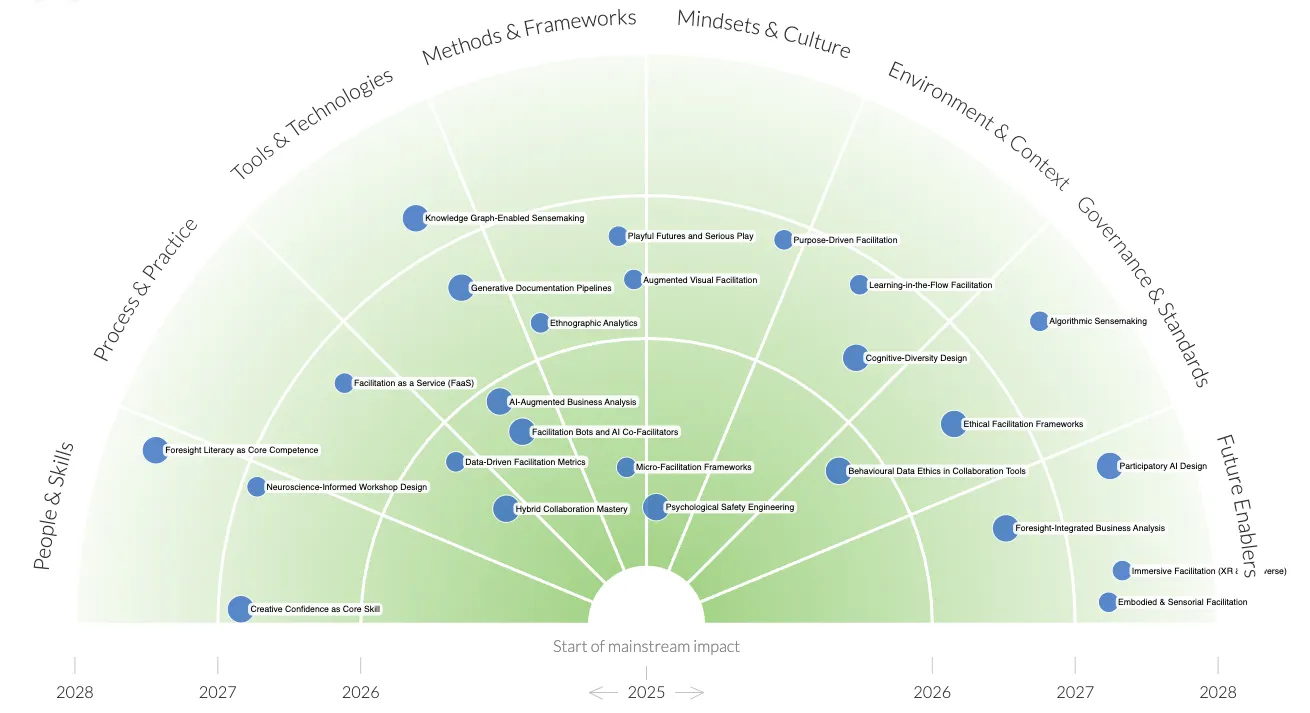
Click the image to open the live interactive radar in a new window. This content is hosted by FIBRES in Finland — by clicking you will be connecting to their servers. You can review their privacy practices in the FIBRES Privacy Policy.
Here’s an embed of the live radar that you are able to interact with and view the trends. As a Fibres user I am able to log in to the radar and see much more behind the scenes including the network view, all the signals and of course make changes and new radars.
When viewed as a whole, the radar shows a field in rapid transformation where the roles of analyst and facilitator appear to be converging into a single, adaptive discipline. For me, five shifts stand out.
1. Human–AI collaboration
Trends such as AI-Augmented Business Analysis and Facilitation Bots point to a near-term (2025–2026) shift from automation to collaboration with intelligent systems. Tools like Miro AI and Zoom AI Companion show how AI is becoming a thinking partner interpreting intent, summarising discussion, and generating drafts. The analyst’s skillset will move from data handling to sensemaking and validation.
2. Hybrid and immersive facilitation
Signals from Microsoft Mesh and Accenture’s VR onboarding show that collaboration is no longer bound to rooms or screens. By 2030, hybrid and immersive facilitation will blend physical and virtual presence, requiring new literacies in behavioural design, inclusion, and spatial thinking.
3. Play and cognitive diversity
The radar highlights a growing emphasis on creativity, inclusion, and embodied learning. From LEGO® SERIOUS PLAY® to EY’s neurodiversity initiatives, companies are rediscovering play as a serious tool for innovation and team insight. Facilitators will increasingly act as creative catalysts, designing playful, psychologically safe spaces for diverse minds to collaborate.
4. Ethics inside the workshop
Trends such as Ethical Facilitation Frameworks and Behavioural Data Ethics in Collaboration Tools reveal that governance and facilitation are merging. As tools capture more behavioural data, professionals must ensure lawfulness, transparency and fairness in collaborative spaces. By 2027, ethical awareness will be an expected professional competence, not an optional principle.
5. Foresight and continuous learning
Signals from OECD and UNESCO show that foresight and learning are becoming structural capabilities. Business analysis will evolve from documenting requirements to anticipating change and embedding learning directly into workflows.
Final reflection
As someone who’s been practising in this field for decades, I’m struck by how much has evolved since that facilitation workshop training 25 years ago.
I develop and use the radars for client work, and assist clients in developing their own as part of their strategic decision to formalise foresight work. For example, earlier this week I completed a radar for a client covering Intelligent Video Surveillance.
The radar I’ve shared in this post doesn’t just map external change, it provides a baseline for assessing my own development path. It’s helped me identify where to invest in new competences for 2026 blending facilitation, foresight, and data-enabled collaboration which has already shaped my next step. In a couple of weeks, I’ll be attending an advanced four-day facilitation training workshop here in Denmark, and I’m so looking forward to getting hands-on with much of what this foresight work has revealed to me.
Purpose and Means can help you establish your in-house practice, or can develop and host your radar using Fibres. To learn more, take a look at my service description and the numerous blog posts I’ve written on this topic that are available below.
Ready to start your foresight work? Book a call to discuss your requirements.