Purpose & Means Newsletter — Issue 7, November 2026
Field Talk starts tomorrow. Five speakers to know, one conference that runs the way it says it does, and what data protection by design actually requires.
1. From the desk #
Due to the global Microsoft outage at the end of last week I decided to wait sending out this issue until today - my reasoning being that it may bounce or get lost.
Field Talk starts tomorrow. I have been building it for months and it still feels slightly unreal that it is a matter of hours away.
Registrations have been strong. At the time of writing, 250 people signed up for Tuesday alone. Fifteen speakers. No sponsors. Every session recorded and free to watch afterwards. It has come together better than I expected and I am grateful to everyone who is speaking.
This issue is the Field Talk issue. It introduces the remaining five speakers you should know about, looks at the conference’s own design as a worked example of data protection by design, and closes the DPIA series with Part 7 - the one about doing any of this inside an organisation that did not ask for it.
2. Data Protection Hero #
3. The DPIA everyone writes and no one uses - Part 7: The add-on #
Part 7 of a short series, and the last. Just joining us? Part 1, Part 2, Part 3, Part 4, Part 5 and Part 6 are here.
Six parts in, this series has taken the DPIA apart and, last time, put six rough sketches on the table for what might replace the heat map.
I do not think the picture is where most practitioners are stuck. They are stuck one step earlier. They have a template they did not design, a GRC tool they did not necessarily choose, an audit cycle that checks one against the other, and a manager who wants the DPIA closed by Thursday. Nobody in that chain asked for a better way of assessing risk to the rights and freedoms of individuals. Six parts of argument do not change that.
So this last part is not about what a good DPIA looks like. It is about what you can do on Monday in a company that is content with the one it has.
Why you cannot replace it #
Through this series I have treated the likelihood-by-severity grid as a bad assessment.
The grid is how the DPIA talks to everything around it. The procedure says every DPIA produces a rating. Whichever tool you are using might not let you close the record without one. The risk function rolls the ratings up. The board report shows the count of reds and ambers. The auditor samples ten DPIAs and checks that each has a rating, an owner and a sign-off, because that is what the procedure says should exist.
Take the grid away and none of those people get a better answer. They get a gap where their input used to be, and you get an audit finding for not following your own procedure.
Attach, do not replace #
The alternative to all this is quite modest, and that is the point. Leave the grid exactly where it is. Fill it in as the procedure demands. Then attach something to it.
Part 6 ended on a rule: the visual never travels without the reasoning attached. I offered it as a guard against the next heat map. It works just as well on the current one. The heat map’s problem was never only that it was a grid. It was that it often sat standalone.
What I am suggesting is an add-on. One page, perhaps two, that sits behind the rating in the same record and follows the DPIA. The law does not forbid it. Few tools reject attachments. No auditor has ever raised a finding for too much reasoning.
Do it on one DPIA. Pick one current assessment where the stakes justify some extra work: large scale, vulnerable minorities, or a decision that will be hard to reverse. Changing a template often needs permission. Doing one assessment properly does not.
What goes on the page #
Five things. Each builds on something an earlier part in this series covered, so I will reference rather than repeat.
The reasoning beside the rating. For each rating the template made you give, one short paragraph: what you think could happen, to whom, and what you based that on. If the paragraph is hard to write, the rating was a guess, and it is better that you find that out than a regulator. ( Part 5 covers what the ICO wanted to see from Snap.)
One question about the edge of the population. Who, among the people this touches, has the most to lose and the least ability to object? Name the specific group. Say what the processing does to them specifically. One group, one paragraph. ( Part 3.)
One sentence of appetite, written first. Before any scoring, write down what outcome would be unacceptable for this processing, and date it. It may feel artificial. It also means that when someone senior later declares a risk tolerable, there is a line on file to compare the declaration against. ( Part 4.)
An owner and a trigger. A named person, and the specific event or trigger that reopens the assessment. Not “annual review”. A new data source, a new user group, an incident, a change of vendor. ( Part 5 again.)
One range instead of one point. For the single harm that worries you most, replace the label with an estimate: roughly how many people, roughly how often, between what and what. This is the part I promised back in Part 2 and have not delivered, and I am not going to deliver it here either, because someone else already has. R. Jason Cronk has set out, step by step, how to estimate frequency and magnitude of harm for an at-risk population. His article for the FAIR Institute is the place to learn the method, and it would be a poor use of your time for me to paraphrase it. The caveat from Part 5 still stands: his frame is privacy harms, and Article 35 asks about rights and freedoms more widely. Borrow the discipline of estimating. Keep the EU Charter of Fundamental Rights as your primary reference - remember we are talking human rights here.
That is the whole add-on. It will not look impressive. It is not meant to.
The people you have not met yet #
This series has talked about engineers, product owners, boards and data subjects. It has not mentioned the two functions often likely to decide whether your add-on survives.
Internal audit. Auditors are routinely cast as the reason nothing can change. In my experience they are closer to the opposite. An auditor tests what the procedure says, so the grid gets checked because the grid is what is written down. But what an auditor actually wants is evidence that a control operates, and a rating with visible reasoning behind it is far better evidence than a rating alone. Show them one DPIA with the add-on before the next audit cycle, not during it. Ask whether it helps. Then ask whether the procedure could mention it as an optional annex for higher-risk processing. One sentence in a procedure is the difference between your personal habit and something the company does. Of course much depends how your internal auditors are positioned in your company and whether they are willing to get their hands dirty. Some prefer to avoid any conflicts of interest.
The risk function. They own the corporate risk method, and Part 4 argued that it does not fit risk to individuals without adjustment. That argument is correct and it is a terrible way to open a conversation. A better one: risk colleagues already know what ordinal scales cannot do. Many of them have been making the case for ranges in operational and cyber risk for years. You are not asking them to abandon their method. You are asking for room to run a better-evidenced input alongside it, which is a request they recognise.
Neither conversation needs a business case. Each needs one finished example on the table.
What this costs #
Time, and it is yours. There is no version of this where the better assessment is also the faster one, and I would distrust anyone who told you otherwise.
It also has a cost of a different kind. Writing down an appetite sentence, a named group and a range makes you easier to hold to account than a colleague who ticked amber. That is the entire purpose, and it will not always feel like an advantage.
What you get in return is slow. The second time a decision-maker reads a DPIA with reasoning attached, the ones without it start to look unfit for purpose. That is how the grid stops being load-bearing: not by argument, but by standing next to something better until people stop leaning on it.
Closing the series #
Seven parts ago I called this a short series. I was wrong about that, and about one other thing.
I started out believing the problem was the instrument. Fix the template, replace the heat map, and the assessments would improve. I end it believing the instrument is mostly a symptom.
I still do not have the replacement picture. Part 6 was honest about that and nothing has changed since. What I have instead is smaller: a page of reasoning that refuses to be separated from the rating, done once, on an assessment that matters, and shown to the two people who can make it normal.
If you try it, tell me what happened. Write to me at tc@purposeandmeans.io. That offer does not close with the series.
4. Tag of the issue: #data-protection-by-design #
Browse the data-protection-by-design tag for posts that work through what Article 25 requires in practice.
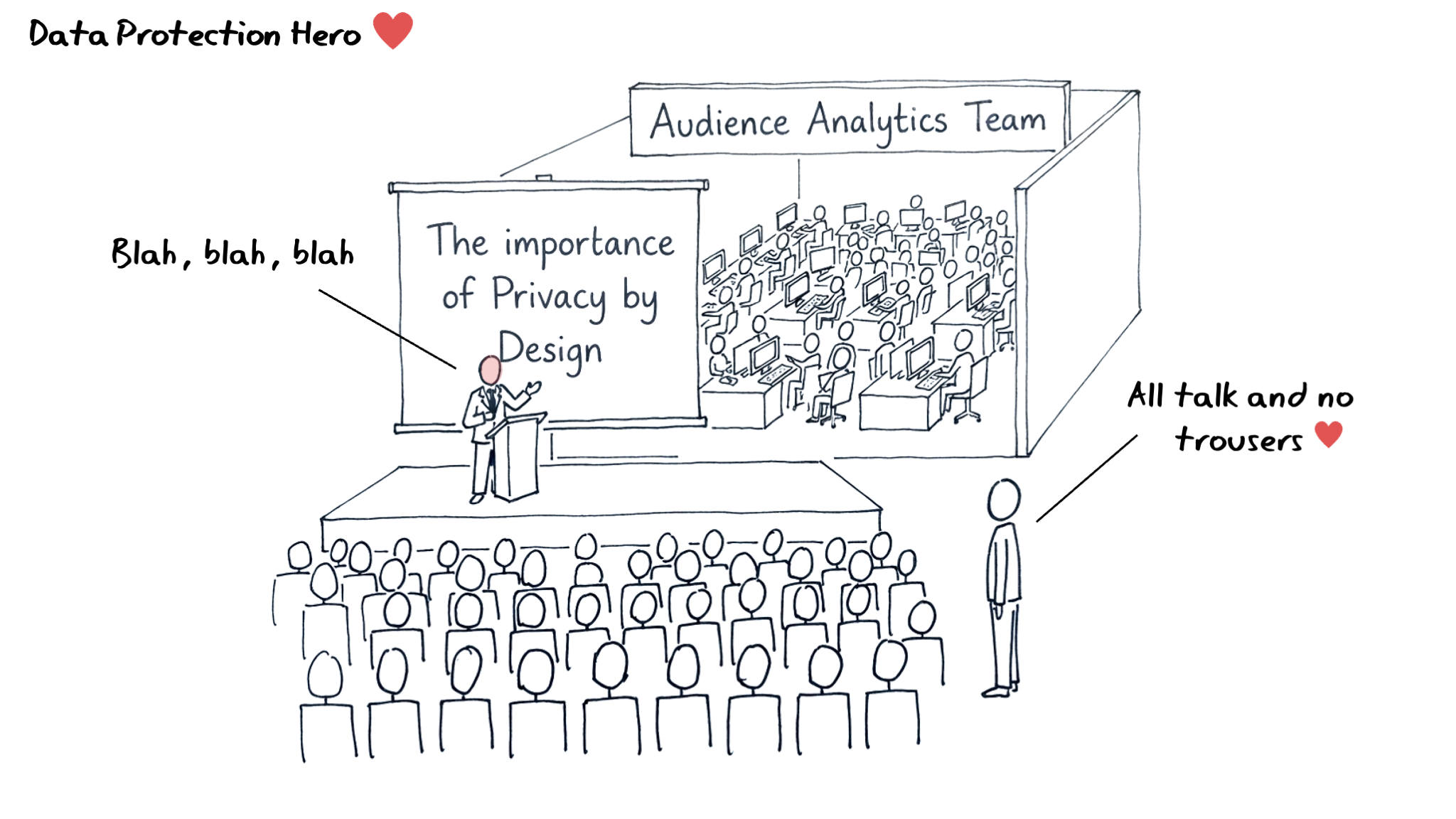
Data protection by design is Article 25 of the GDPR. Not a principle, not a philosophy, not a recommended approach. A legal obligation. Controllers must implement technical and organisational measures designed to give effect to data protection principles and safeguard the rights of data subjects - and they must do this at the time of determining the means of processing, not after the product has shipped.
The phrase “privacy by design” is older. Ann Cavoukian coined it in the 1990s. The GDPR took the concept and made it binding law under a different name: data protection by design and by default. The two are not interchangeable. Privacy by design is Cavoukian’s broader, voluntary seven-principle framework. Data protection by design is what Article 25 requires. The distinction matters - particularly now, with the Digital Omnibus working its way through the Council and Parliament and proposed changes to how pseudonymised data is treated sitting in the middle of that debate.
The tag has a Field Talk connection. Olivia Roth’s session on AI governance in practice and Telma Candeias’s session on the AI governance gap are both, at their core, questions about data protection by design - what it means to build privacy-respecting systems when the system learns, infers and predicts. The DPIA series is too: a DPIA is one of the instruments Article 25 produces. When you work through what a DPIA should actually show, you are working through what data protection by design requires.
Field Talk itself is built on the same logic. Registration asks for an email address. A name is optional. You can sign up per day rather than for the whole event. The live stream runs on Owncast - open, no account required. Recordings go to PeerTube. The mailing lists are retired after the event. None of this is in a privacy policy. It is in the design.
5. Field Talk - it starts tomorrow! #
Field Talk runs Tuesday 17 to Thursday 19 November 2026. Free, online, fifteen speakers. Register at fieldtalk.eu/register - email only, name optional, per-day sign-up, newsletter opt-in not pre-ticked. Recordings will be published afterwards on the website after the event.
This issue I am introducing the five remaining speakers.
Olivia Roth #
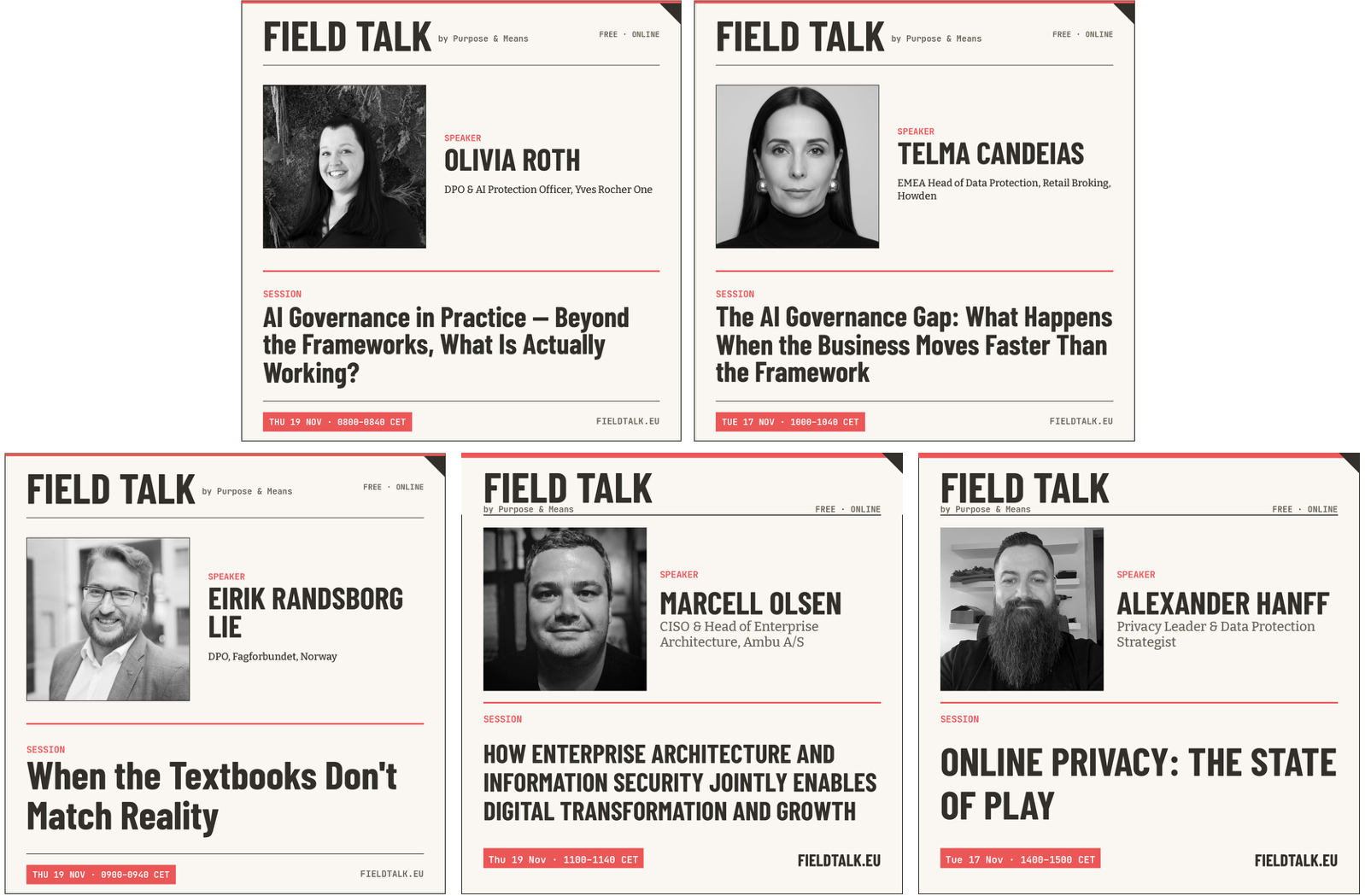
Olivia is DPO and AI Protection Officer at Yves Rocher One. Her session, AI Governance in Practice - Beyond the Frameworks, What Is Actually Working? (Thursday 19 November, 0800-0840 CET), is about what it actually looks like when those conversations happen in one place, with one person holding both briefs for data protection and AI governance.
Telma Candeias #
Telma is EMEA Head of Data Protection, Retail Broking, at Howden. Her session, The AI Governance Gap: What Happens When the Business Moves Faster Than the Framework (Tuesday 17 November, 1000-1040 CET), is about the gap between what organisations say they are doing on AI governance and what they are actually doing. It is a familiar shape in data protection generally - policy in one place, practice somewhere else. Telma’s session looks at where the gap sits in the AI context and what closing it actually requires.
Eirik Randsborg Lie #
Eirik is DPO at Fagforbundet, Norway’s largest trade union, representing around 400,000 members. His session, When the Textbooks Don’t Match Reality (Thursday 19 November, 0900-0940 CET), is the kind of session that tends to be the most useful at any conference. An honest account of the gap between how data protection is supposed to work and how it works inside a large, complex organisation. Practitioners learn more from that gap than from the textbooks that produced it.
Marcell Olsen #
Marcell is CISO and Head of Enterprise Architecture at Ambu A/S. His session, How Enterprise Architecture and Information Security Jointly Enables Digital Transformation and Growth (Thursday 19 November, 1100-1140 CET), is about the practical mechanics of running security and architecture together - and what that combination makes possible when a business is genuinely trying to grow rather than just trying to stay compliant.
Alexander Hanff #
Alexander is a Privacy Leader and Data Protection Strategist. His session, Online Privacy: The State of Play, opens on Tuesday 17 November at 1400 CET and runs for an hour - but it is not an overview.
Alexander has spent months auditing 100 global websites. He will publish his findings during the session. The findings cover a range of data protection and privacy violations - the kind of audit that produces real data rather than general observations. If you want to understand what online privacy looks like in practice rather than in policy, this is the session to watch.
Nathan Kinch #
Although I introduced Nate in an earlier newsletter, I want to highlight his session, How to do AI ethics when all you have is a napkin, because it does not aim to only inform. It aims to put you to work.
Participants will enter a shared digital canvas and work through the session together with Nate - not watching, doing. The focus is on what AI ethics actually requires in practice, without the resources, the frameworks and the institutional backing that most AI ethics writing assumes you have. If you are the person in your organisation trying to make this real on limited time and no dedicated budget, this session is for you. His session is on day 3, Thursday 19 November starting at 0700 CET.
A word of thanks. I will be assisted throughout Field Talk by Conor Hogan, who got in touch several months ago and offered a hand. I took him up on it and I am very grateful. Thank you, Conor.

Can’t attend? All sessions are being recorded and will be made available free of charge on the Field Talk platform after the event. Register at fieldtalk.eu/register for a reminder when recordings go live.
6. What caught my eye #
CJEU: data protection authorities are themselves data controllers - On 5 November, the Court of Justice ruled that when a DPA handles a complaint, it acts as a data controller and must in principle give complainants access to their own personal data under the GDPR. It also rejected a blanket national exclusion from that right. Worth reading if you work in or alongside a supervisory authority. ppc.land
Palantir lobbied to extend NHS AI tool to GP records - The Guardian reported on 9 November that Palantir lobbied UK ministers to expand the reach of its NHS data platform to include GP records - the most sensitive and comprehensive data the health service holds. A reminder that data protection by design has to contend with procurement decisions and commercial pressure, not only technical architecture. theguardian.com
Humans have rights. Machines do not. - Allison Stanger and Bruce Schneier, writing in Tech Policy Press on 11 November, take on the habit of AI companies claiming First Amendment protection for their systems’ outputs while denying liability for the harms those outputs cause. The piece proposes three measures: liability for automated outputs unless a human adopts them, treating engagement-optimised feeds as platform conduct, and disclosure for machine-generated political communication. techpolicy.press
EU watchdogs put AI recruitment in the enforcement spotlight - The EDPB has announced that its 2027 Coordinated Enforcement Action will focus on automated decision-making in recruitment - the same area where the EU AI Act classes many tools as high-risk. If your organisation screens candidates using any automated scoring or filtering, now is the time to review whether you have a DPIA and whether Article 22 obligations have been considered. iapp.org
Pennsylvania enacts AI deceptive advertising law - On 13 November, Global Policy Watch reported that Pennsylvania’s governor signed the Artificial Intelligence Deceptive Advertising Act, requiring advertisers to disclose AI-generated or AI-modified content where it could mislead consumers about a product’s nature or origin. US state-level AI legislation continues to move faster than federal action. globalpolicywatch.com
Hire me #
I work with organisations as an external data protection and GRC consultant - on GDPR programmes, risk and compliance frameworks, DPIAs, training, and wherever the gap between policy and practice needs closing. I am also available to speak and to consult specifically on how to make data protection by design something your product teams actually do, rather than something they sign off on. If that sounds useful, write to me at tc@purposeandmeans.io.
7. Running it myself #
The hardest part of running anything yourself is the first step - getting the hardware ready. Applications come later. The most useful thing I can tell you is that you probably already have the hardware.
My partner’s laptop was more than ten years old. It was running slowly, the battery was unreliable, and it was overdue for replacement. Instead of replacing it, I installed Linux Mint. It runs well. I actually think it is faster than it was under Windows. The laptop is not powerful by current standards but Linux Mint is not designed for powerful hardware. It is designed for exactly this situation - an older machine that the original operating system had long outgrown.
I found a similarly obsolete laptop in my desk. Same result. Linux Mint installed cleanly, runs without complaint, and again is noticeably faster than it was under Windows (or so I think).
This is the best place to start. Find an old laptop - one you stopped using because it was slow, not because it was broken. Download Linux Mint from linuxmint.com, write it to a USB drive, and boot from it. You can try it without installing anything at all. If you like what you see, install it. There are many videos on Youtube that will walk you through this relatively easy process.
If you have a mini PC or a desktop machine you can dedicate to this, you have more options. Ubuntu Server installs on the same kind of hardware and opens up the full range of self-hosting possibilities - running your own services, your own storage, your own tools. Again, Youtube has many useful videos on this topic. The next issue will cover what that actually looks like and how to get started.
For now: find the old laptop. That is the starting point.