Over-reliance: when tools stop helping and self-doubt creeps in
Balancing AI progress with accountability, this post explores the risks of over-reliance and the need for strong governance to maintain control
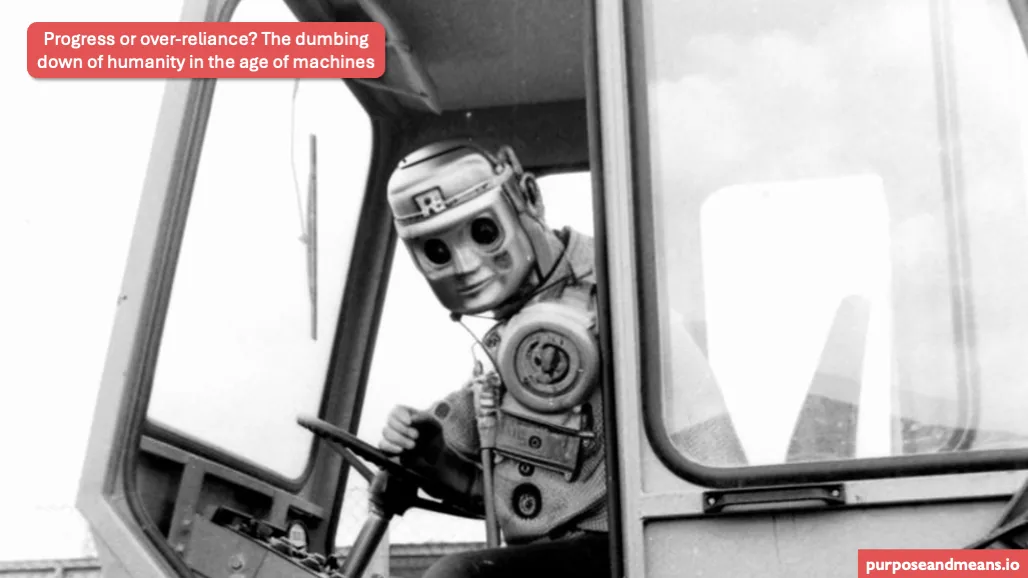
AI is certainly changing how we work, and whether we like it or not, how we live. From robots operating construction equipment to algorithms optimising workflows, machines are taking on tasks once thought to require uniquely human skills. At first glance, this looks like undeniable progress. But is it really progress if over-reliance on these tools starts eroding our abilities and creating unforeseen consequences?
The issue with over-reliance isn’t just about convenience. It’s about what happens when we outsource too much - skills, judgment, and even responsibility. Consider these commonplace examples:
Mental arithmetic: once a dreaded subject at school (it least for me), mental arithmetic has largely been replaced by calculators. While calculators are indispensable for complex computations, their overuse has undermined confidence in basic mathematics. Many of us now second-guess simple sums without a device in hand. What happens if the tool isn’t available when we need it?
Navigation apps: GPS has made getting around effortless, but at a cost. Before apps, we memorised routes, used landmarks, and developed spatial awareness. Now, even familiar routes feel daunting without step-by-step guidance. Over time, we lose our ability to navigate, becoming overly dependent on technology to tell us where to go.
Activity trackers: fitness apps provide detailed insights into our physical activity, but they’ve shifted how we gauge effort. Runners used to listen to their bodies, relying on intuition to measure progress. I use a sleep tracking app. If the device says my sleep wasn’t ‘optimal,’ I’m inclined to believe it - even if I feel great. The reverse is also true - I may have had a terrible nights sleep, but the app tells me I can push myself harder! This undermines trust in our instincts and our bodies.
These tools, while valuable, do plant seeds of doubt. Over time, confidence erodes, and dependence grows. What’s worse, over-reliance often creates blind spots that make us vulnerable when things go wrong.
With AI, the stakes are even higher. Machines are taking on tasks like decision-making, problem-solving, and predictive analysis. But what happens when AI makes mistakes or fails entirely? If we’ve handed over too much control, do we still have the skills and judgment to intervene?
The consequences of over-reliance can be significant:
Loss of critical skills: over-reliance on AI can lead to skill degradation. Once humans no longer practice or develop essential abilities, reacquiring them becomes much harder. Imagine trying to navigate without GPS after years of letting it do the thinking for you.
Reduced accountability: when decisions are outsourced to algorithms, accountability becomes murky. Who takes responsibility when an AI system makes a flawed decision - its developers, the user, or the machine itself?
Systemic vulnerability: over-reliance creates single points of failure. If an AI system crashes or produces incorrect outputs, businesses, and individuals alike may find themselves unprepared to adapt or recover quickly.
Erosion of trust: blind reliance on AI can lead to disillusionment when systems fail. Once trust in a technology is broken, rebuilding it becomes a significant challenge.
Ethical blind spots: AI doesn’t understand context, ethics, or nuance. Over-relying on it can lead to decisions that ignore important human considerations, from fairness to cultural sensitivity.
Proper governance is key to mitigating these risks. Businesses need people with the right skills, technical expertise, and ethical grounding to oversee AI deployment and ensure it’s used responsibly. Strong governance frameworks must answer questions like:
Are we using AI to enhance human ability, or to replace it entirely?
What safeguards are in place if systems fail?
Do employees have the skills to step in when the technology falters?
And, context is critical, too. AI is invaluable in some situations, like improving safety in hazardous work environments or analysing vast datasets for medical diagnoses. But in other scenarios, it risks replacing judgment, intuition, and adaptability - qualities that only humans bring to the table.
The consequences of over-reliance aren’t just theoretical - they’re already playing out in everyday life. Progress isn’t inherently good if it comes at the cost of our capabilities. The real challenge lies in finding the balance: leveraging AI’s potential while ensuring we maintain control, accountability, and the skills that define us.