Say Goodbye to Boring Training: The Power of Interactive Scenarios
I want you to think back to the last training session you attended. How memorable was it? Did you spend hours staring at your screen, passively absorbing information you barely remembered the next day? If so, I know exactly how you feel. This approach to training is not always effective, it’s uninspiring, and inefficient.
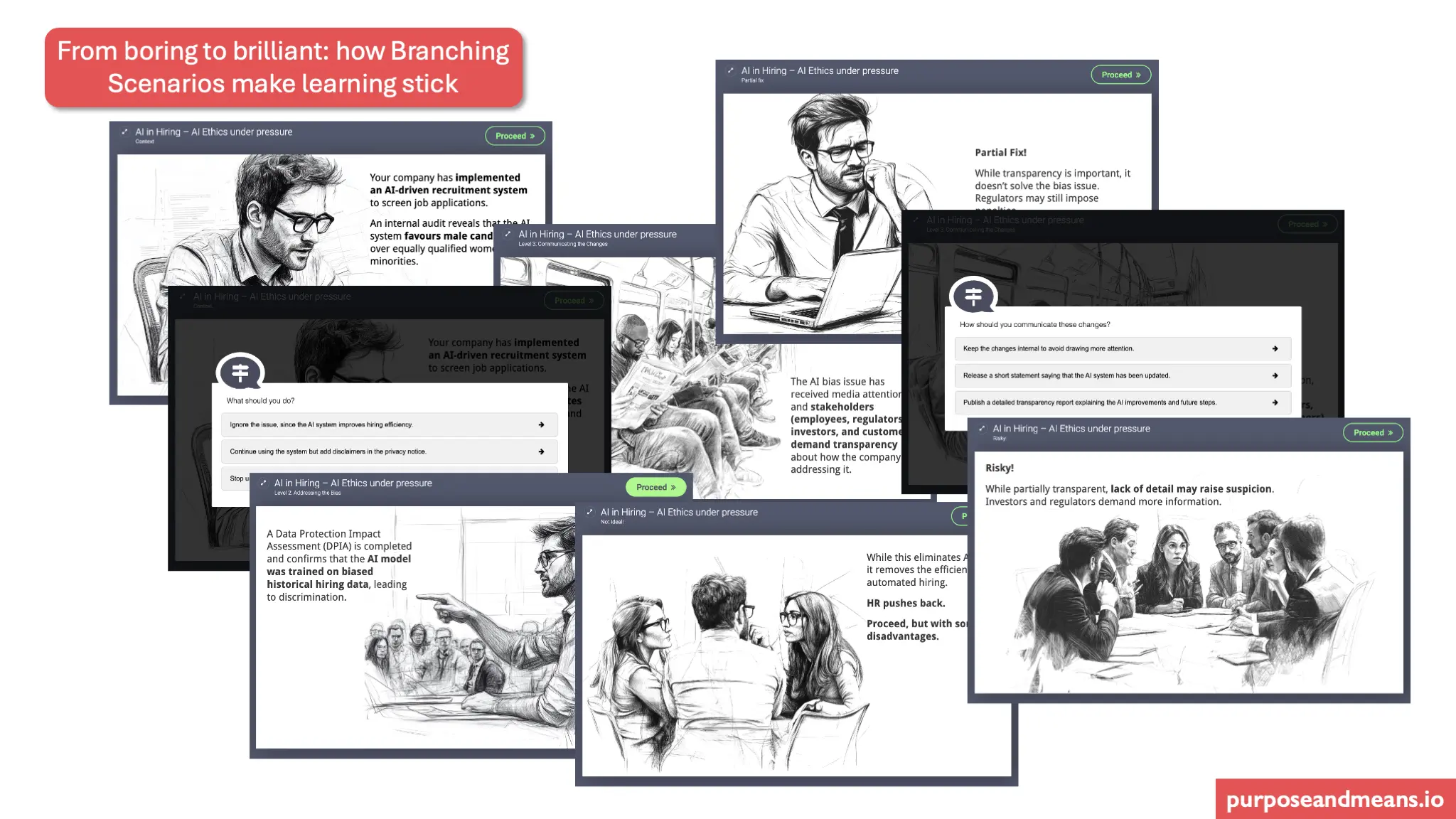
Now, imagine a different kind of learning experience, one where you are put in real-world dilemmas, where you have to make choices, and see the direct consequences of your decisions. This is the power of branching scenarios.
Why traditional education and training falls short #
Most corporate training is designed to check a box. I’ve sat through those long lectures myself, skimmed through endless slides, often just full of bullet points. If it’s in-person training, the room may be full, and the bigger the class, the fewer questions get asked. But when real-world situations arise in the workplace, such as a personal data breach, an ethical dilemma, or a decision about AI governance, you don’t have time to search your memory bank for that one slide from three months ago.
Branching scenarios change this dynamic by transforming passive learning into active problem-solving. Instead of dumping information on you and hoping some of it sticks, these scenarios force you to think critically, make decisions, and see the results of your choices in real time.
Training tailored to your corporate reality #
No two companies are the same. The challenges you face are unique to your industry, your company culture, and your specific regulatory environment. That’s why generic training modules often may not be appropriate. Branching scenarios can be designed around the actual dilemmas you’re likely to encounter.
For example, in a financial services context, you could navigate a scenario where you must decide whether to flag a suspicious transaction for potential money laundering. In a tech company, a branching scenario could focus on ethical AI governance, guiding you through the nuances of algorithmic bias and data protection concerns.
Rather than being told what you should do, branching scenarios let you experience, or at least get a sense of, what happens when you make the wrong choice, and that lesson is far more memorable than any slide deck.
Learning from real-world events #
Training is most effective when it’s relevant. Branching scenarios can be built around actual events, such as personal data breaches, security hacks, or regulatory violations, to ensure you see the real consequences of decisions made in the workplace.
For example, you can take any case involving a company that may have come under the scrutiny of a Supervisory Authority and re-enact the sequence of events that the investigation reveals. Or it could be a company that’s recently suffered a cyber incident due to an employee clicking on a phishing email. A branching scenario could replicate that situation, allowing you to choose whether to open an email, report it, or ignore it. If you choose incorrectly, you witness the full-scale impact of a cyberattack, and all the consequences that could arise. During data protection week a month ago, I developed a branching scenario for a client that had recently updated it policy for incident reporting and used this very example.
Learning from the misfortune of others, especially if you know deep down that whatever the incident could have happened to your company, is something I encourage my clients to invest in.
This kind of training doesn’t just educate, it sticks. When you personally experience the fallout of your decisions (even in a simulated environment), you are far more likely to internalise the lesson and apply it in the real world.
Bridging the gap between policy and practice #
How often do you update your policies? Even if it’s regularly, how confident are you that your employees fully understand how those policies apply to their daily work, in their contexts?
Branching scenarios can be used to support the roll out of new policies, processes, or procedures by embedding your employees in realistic situations where they must apply those policies. Rather than simply being told about a new AI Acceptable Use policy, for example, a scenario could require your employees to determine the correct use of GenAI tools depending upon the type of data. This ensures that they not only understand the new policy but also practice applying it in a risk-free environment.
Perfect for AI governance, data protection, and beyond #
Few areas of corporate training require as much nuance and critical thinking as AI governance and data protection. These are fields where the right decision isn’t always clear-cut, and employees must navigate gray areas where the wrong choice can have significant ethical, legal, or financial consequences.
Branching scenarios are particularly valuable in these areas because they encourage employees to think through complex situations and weigh up conflicting priorities. Should a machine learning model prioritise accuracy over fairness? What should an employee do if they suspect customer data is being misused? These are not questions that can be answered easily trying to remember from slides of endless bullet points. They need practice making decisions in scenarios before they face them in the reality of their workplace.
Integration with your corporate ecosystem #
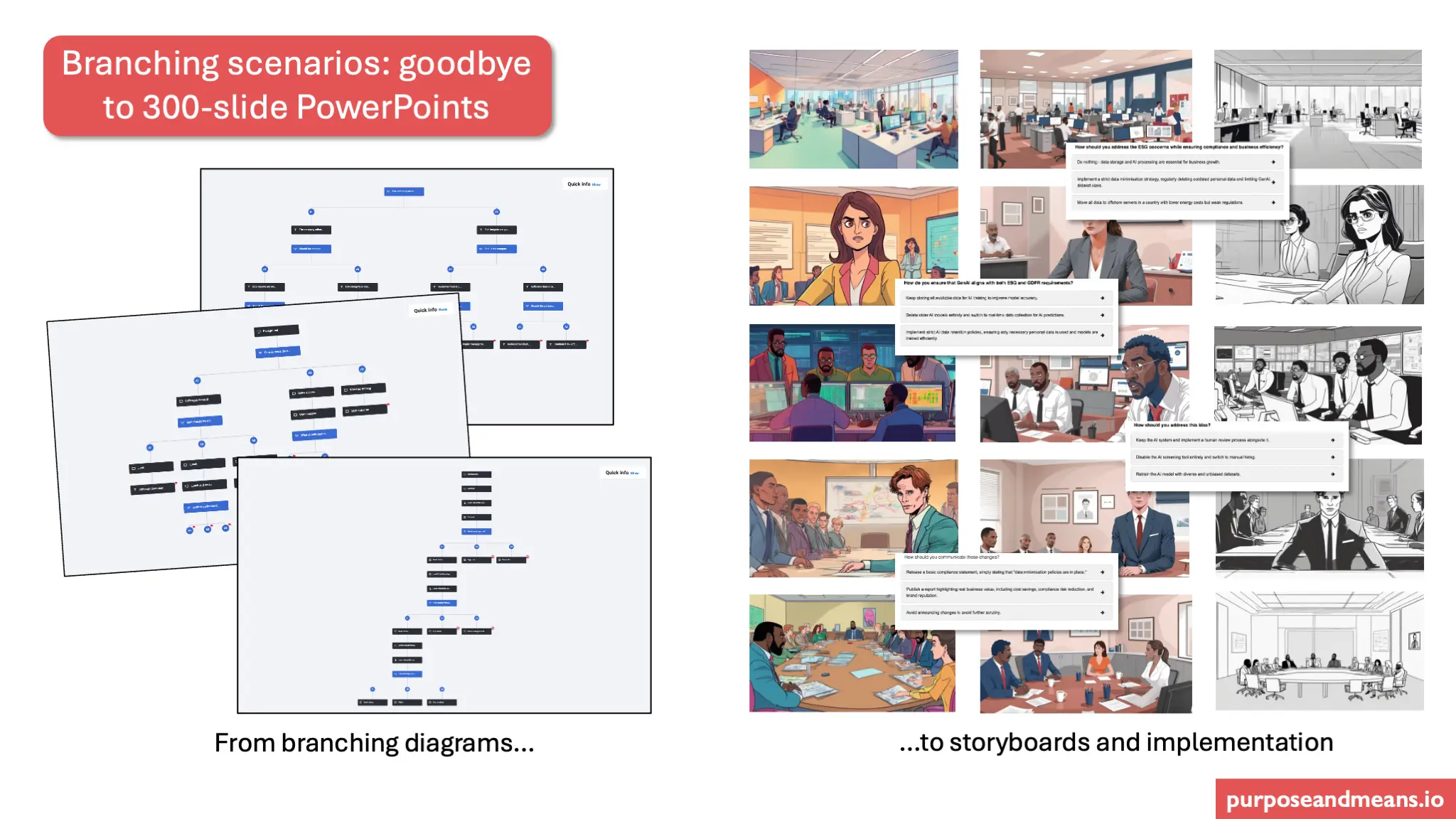
Branching scenarios are not only engaging but also highly adaptable to your company’s existing systems and branding. The graphical interface can easily be aligned with your company’s corporate visual identity, ensuring a seamless look and feel that integrates effortlessly with your existing internal training materials. In the graphic accompanying this post, I’ve shown a few variations in terms of style, but in reality, there are many options.
Also, the finished branching scenario can be added to your Learning Management System (LMS) via an LTI connection, or, embedded into the SharePoint pages on your intranet, or accessed directly from our hosting provider. This flexibility allows you to deploy training in a way that best suits your company’s needs while ensuring easy accessibility for employees.
The future of training is interactive #
The days of monotonous training sessions should be behind us. We don’t need more slides, more lectures, or more memorisation drills. Your employees need training that is engaging, immersive, and applicable to their daily work.
So, the next time you’re planning an employee training programme, ask yourself: do your employees really need another PowerPoint presentation? Or is it time to step into the future with branching scenarios?
Interested? Feel free to get in touch to arrange a no obligation call to discuss your requirements, where I’ll also happily share some demos of branching scenarios.
As a side note, I first came across this approach to employee engagement back in the late 90s whilst working on a project for a Danish pharma giant who were publishing their groundbreaking Social Report online. We jointly developed a number of dilemmas supporting their policies in this area. One that stood out was a dilemma around what to do if you discovered a colleague secretly consuming alcohol at work!
Purpose and Means is a niche data protection and GRC consultancy based in Copenhagen and operating globally. We work with companies providing services with flexibility and a slightly different approach to the larger consultancies. We have the agility to adjust and change as your plans change. Take a look at some of our client cases to get a sense of what we do.
We are experienced in working with data protection leaders and their teams in addressing troubled projects, programmes and functions. Feel free to book a call if you wish to hear more about how we can help.