The convergence of AI Governance, Data Protection, and ESG
AI Governance, Data Protection, and ESG (Environmental, Social, and Governance) should no longer be siloed departments. They are converging into a single operational imperative. If you are a Data leader, you are also an ESG leader. If you are an Infrastructure leader, you are also a Tech risk officer.
For the past few years, AI has, in some companies, been defined by speed: How fast can they build, how fast they can deploy, how fast can they disrupt. But our latest foresight analysis suggests that the era of “move fast and break things” is coming to an end.
As we move into 2026, a new megatrend is dominating the horizon: Convergence**.**
AI Governance, Data Protection, and ESG (Environmental, Social, and Governance) should no longer be siloed departments. They are converging into a single operational imperative. If you are a Data leader, you are also an ESG leader. If you are a Infrastructure leader, you are also a Tech risk officer.
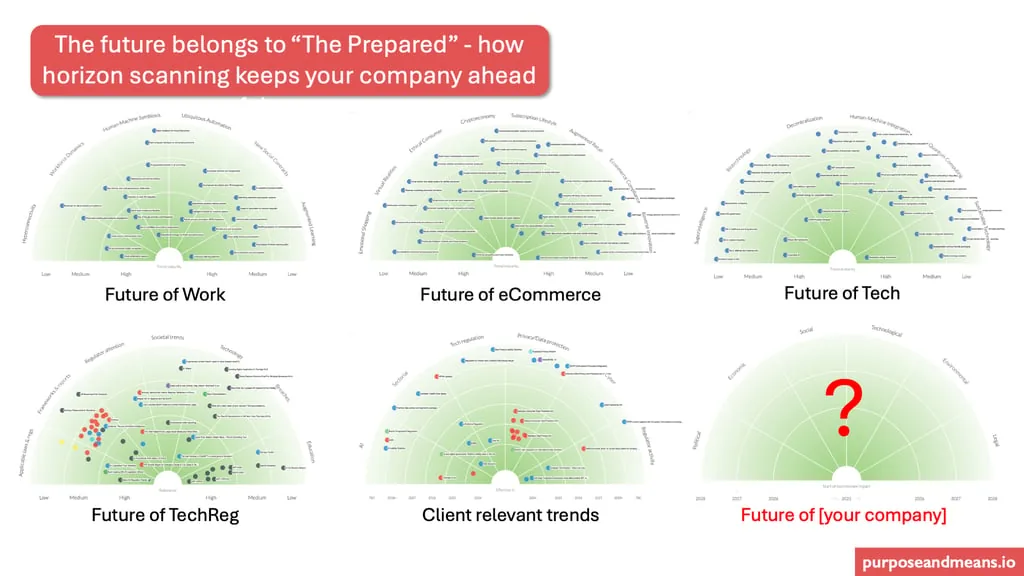
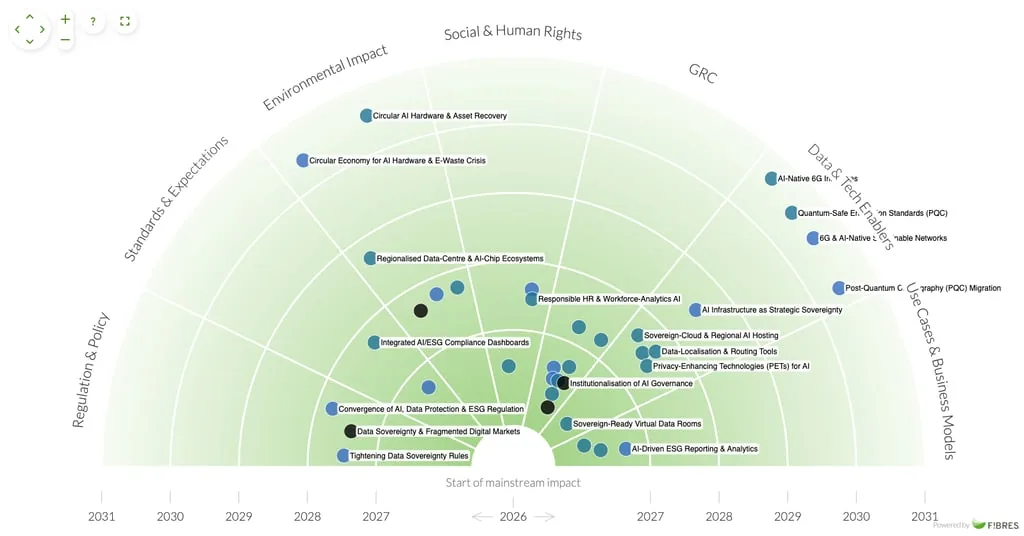
Based on our latest radar developed and published this month, tracking over 50 technologies and signals, here are the four shifts that will define the next five years (an interactive version of the radar is available below).
1. Compliance is in code
The days of vague “AI Ethics” principles on a website are gone. With the Institutionalisation of AI Governance, boards now face fiduciary liability for algorithmic failures.
The shift we see on the radar is purely operational. It is the move from policy to platform.
The Insight: You cannot manage 2026-era regulation with spreadsheets.
The Tool: We are seeing the rapid adoption of Automated AI Governance Platforms and Compliance Tools. These systems hard-code legal requirements into the development pipeline. If a model doesn’t pass the fairness check, it doesn’t deploy.
2. Trust is the new procurement gate
Perhaps the signal that stood out in our research is the rise of Standards & Expectations. Trust is moving from a sentiment to a certificate.
The signal: We are seeing a significant increase in ISO 42001 adoption.
The reality: Within the next couple of years, a lack of certification will become a barrier to entry. Major buyers in finance, health, and the public sector will lock out vendors who cannot prove their governance.
3. Digital is physical
Our radar revealed a key megatrend, Scrutiny of AI’s Footprint. GenAI is a heavy industry. It consumes vast amounts of water and energy, and creates physical waste.
The crisis: By 2030, we face a potential E-Waste Crisis as millions of AI chips hit end-of-life.
The strategy: ESG strategies must cover the digital supply chain. This means implementing AI Carbon Accounting to see the true cost of compute, and mandating Circular Hardware procurement to ensure your old servers are recycled, not dumped.
4. Geography is destiny
Data Sovereignty & Fragmented Digital Markets is a megatrend that reveals a fragmented future where data sovereignty dictates IT architecture.
The shift: As geopolitical tensions rise, data laws are becoming borders.
The tech response: We are moving toward a “multi-sovereign” architecture. Companies are deploying Sovereign Clouds and smart Data-Localisation & Routing Tools that automatically keep German data in Germany and Canadian data in Canada. Your infrastructure strategy is now a geopolitical strategy.
2030 and beyond
Our radar also picked up two faint but critical signals on the outer rim:
Quantum is ticking: Companies with long-life data (e.g., pension records) must start their Post-Quantum Cryptography** **migration now, not in 2029.
The 6G economy: By 2030, AI-Native 6G** **will allow devices to autonomously negotiate their own connectivity and energy usage, creating a machine-to-machine economy that needs entirely new governance rails.
To conclude, the companies that will succeed in the next decade won’t just be the companies with the most powerful AI. They will be the companies with the most governed AI.
They will be the companies that successfully merge their CISO, CDO, and ESG mandates into a unified strategy. They will use technology not just to innovate, but to prove they can be trusted.
The radar below was made using the FIBRES tool - worth looking at if you wish to enhance your foresight capability. Need help in establishing foresight capabilities in your company? Get in touch to hear more about our service offering. And for information about how we can help your company build stronger collaboration across your existing silos, take a look at our AI, data protection and ESG service page.