Reflections from Lisbon: Why physical space is an underrated innovation tool
Physical space is an underrated tool in innovation, crisis response, and strategic decision-making. A lot of companies invest heavily in software, frameworks, and methodologies — yet hold their most consequential workshops and crisis meetings in rooms designed for quarterly business reviews. When the complexity of a problem exceeds what individuals can make sense of in their heads, you have to build a room, because the room itself becomes the tool.
I experienced this first-hand at a weekend workshop at the NOVA IMS Innovation & Analytics Lab in Lisbon. It was hands-on, educational, and full of energy — and much of that energy came directly from the space itself.
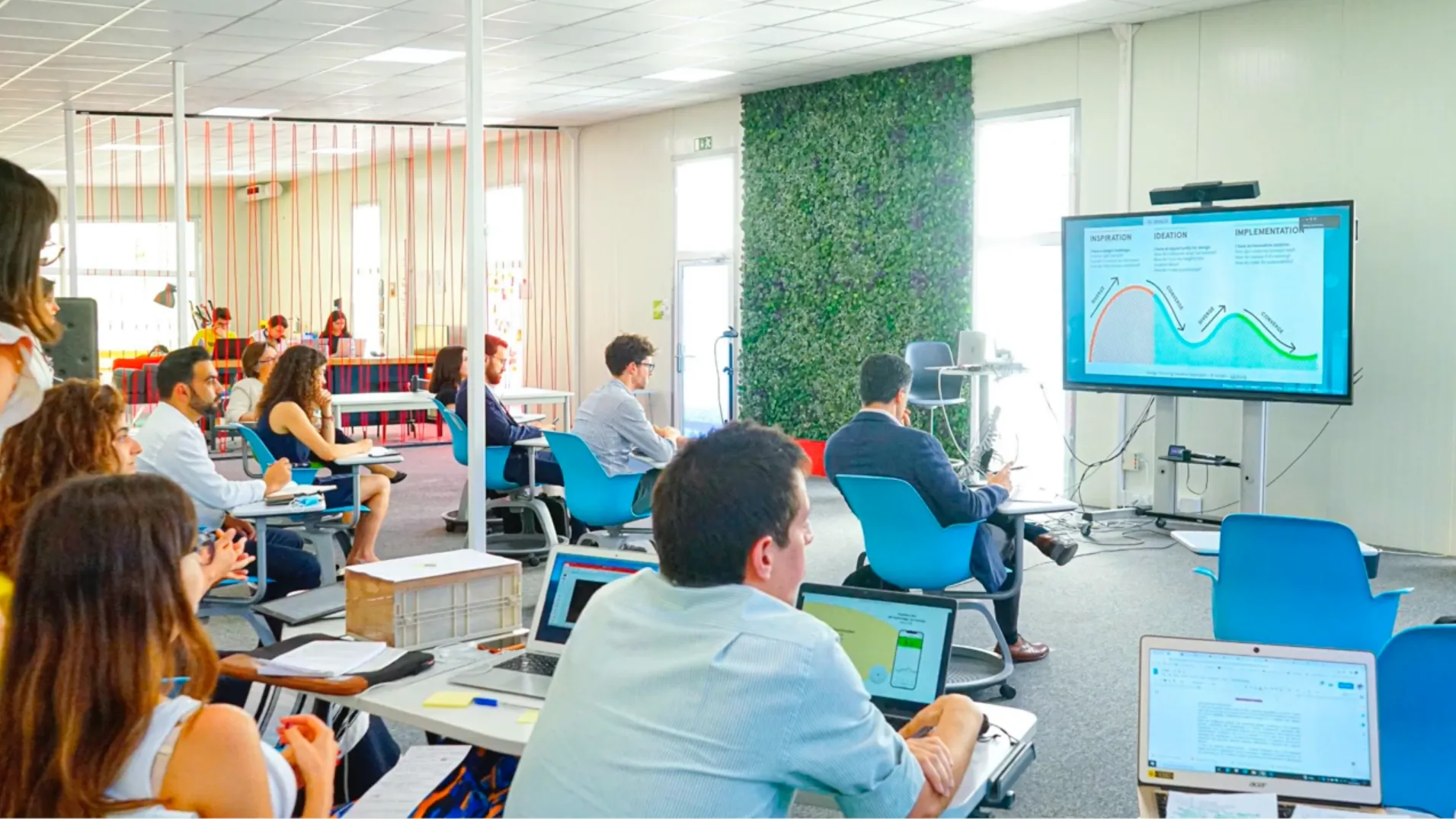 Inside the lab (not our workshop) Photo: NOVA IMS Innovation Lab
A room designed to think with you #
At the start of the session, Guilherme Victorino — Associate Dean at NOVA Information Management School and Director of the Innovation & Analytics Lab — introduced the space and its history. The physical environment had been deliberately designed to optimise creativity and collaboration using the SALIENT framework from behavioural scientist Paul Dolan at LSE — Sound, Air, Light, Image, Ergonomics, Nature, and Tint. Visual boards surrounded us on every wall, and even the chairs swivelled in ways that encouraged movement and conversation.
The lab began in what Guilherme described as a forgotten prefab building, transformed into a hub for innovation. The ambition was to prototype a classroom that learns from its users as much as they learn from it. What they discovered was that when you co-create a space with its users, they don’t just use it — they belong to it. Guilherme calls this the IKEA effect. But the ambition went beyond furniture: they were prototyping an innovation culture. All of this is explained in Guilherme’s TED Talk.
A room that listens to the sky #
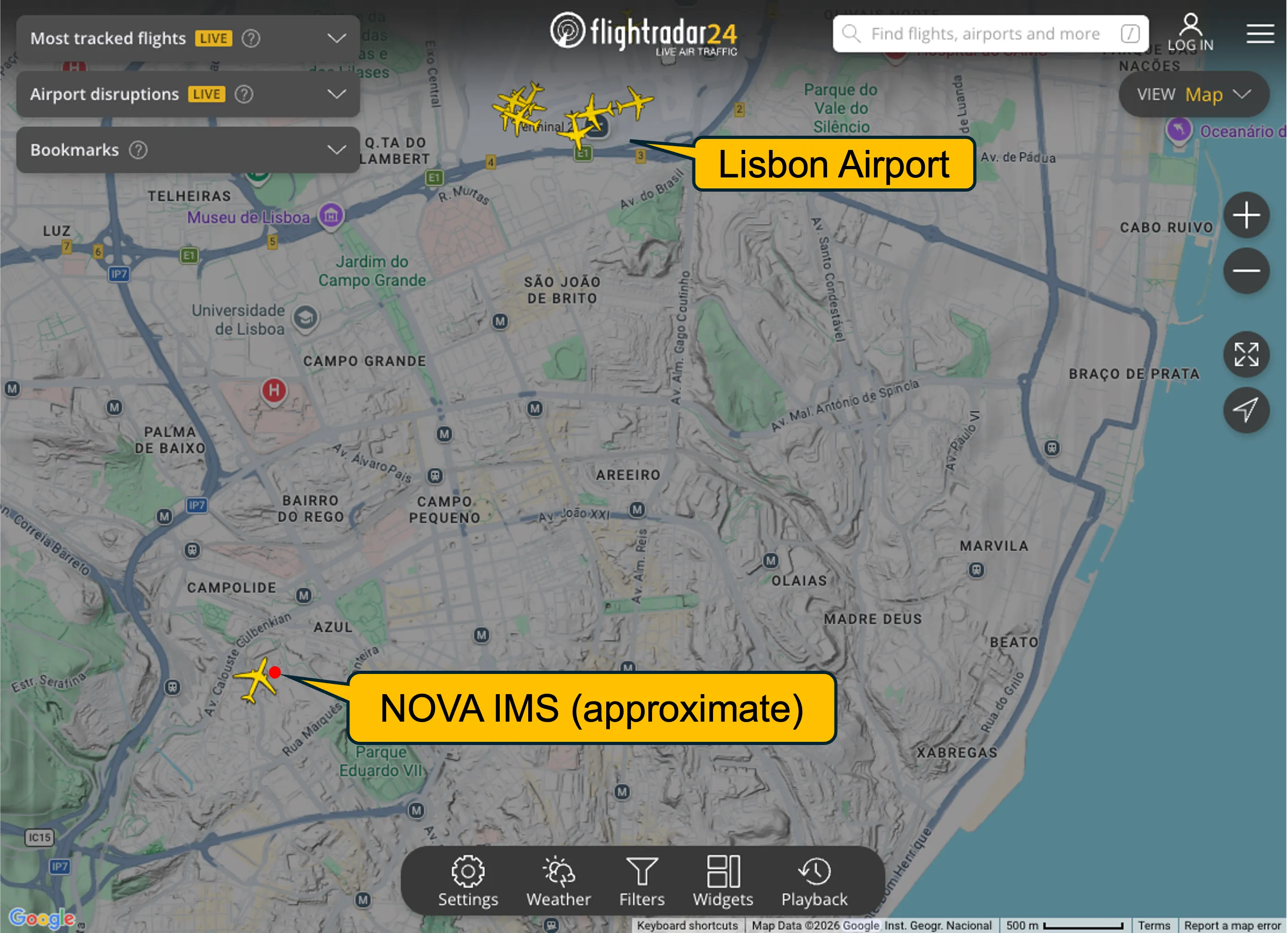
The lab sits directly under a flight path to Lisbon airport. Rather than treat this as a nuisance, the team turned it into a design feature. They connected the room to a live FlightRadar feed and installed lights that flash different colours as a plane approaches — a visual cue for facilitators to switch to exercises that won’t be drowned out by the roar overhead.
It captures something profound about the philosophy of the space. Instead of fighting the environment, they embraced it. They made the invisible visible and turned a constraint into a tool. Guilherme described this as part of a broader “professor’s cockpit” where facilitators can manage ambience — smell, temperature, lighting — and build on analytics that measure impact on the learning process. The room doesn’t just contain the workshop. It actively participates in it.
The rooms that haven’t changed #
This reminded me of something I read about seven years ago — a blog post by the then UK government advisor Dominic Cummings, referencing the work of Bret Victor. He made a face palm-like observation: the British Cabinet room is virtually unchanged since the 19th century. There are effectively no tools. The fireplace — once used by Lord Salisbury to burn sensitive papers — is now blocked. The clock didn’t work.
Meanwhile, NASA had long understood that when you’re managing genuine complexity, you have to build a room — a spatial environment where you can see and understand every aspect of the system. The contrast is unmissable: the people managing the most complex technical systems have purpose-built environments for seeing and understanding, while the people making decisions about billions of lives sit around the same table their predecessors used before WW1!
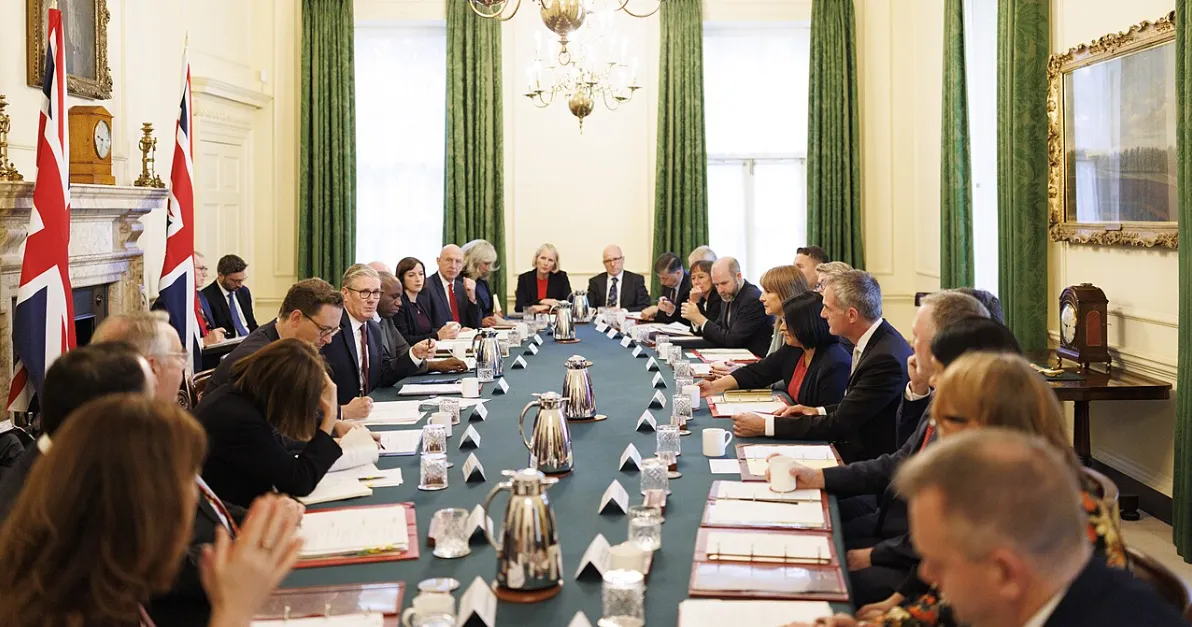 The British cabinet room in September 2025 - no live data feeds - is this really the environment for solving national and global challenges? Photo: https://commons.wikimedia.org/w/index.php?curid=176364449
Here I was in Lisbon, in a university lab with lights that respond to air traffic, a dashboard that reads the room’s vital signs, and chairs designed to make you turn toward the person next to you — and it had more situational awareness than most government and corporate crisis rooms.
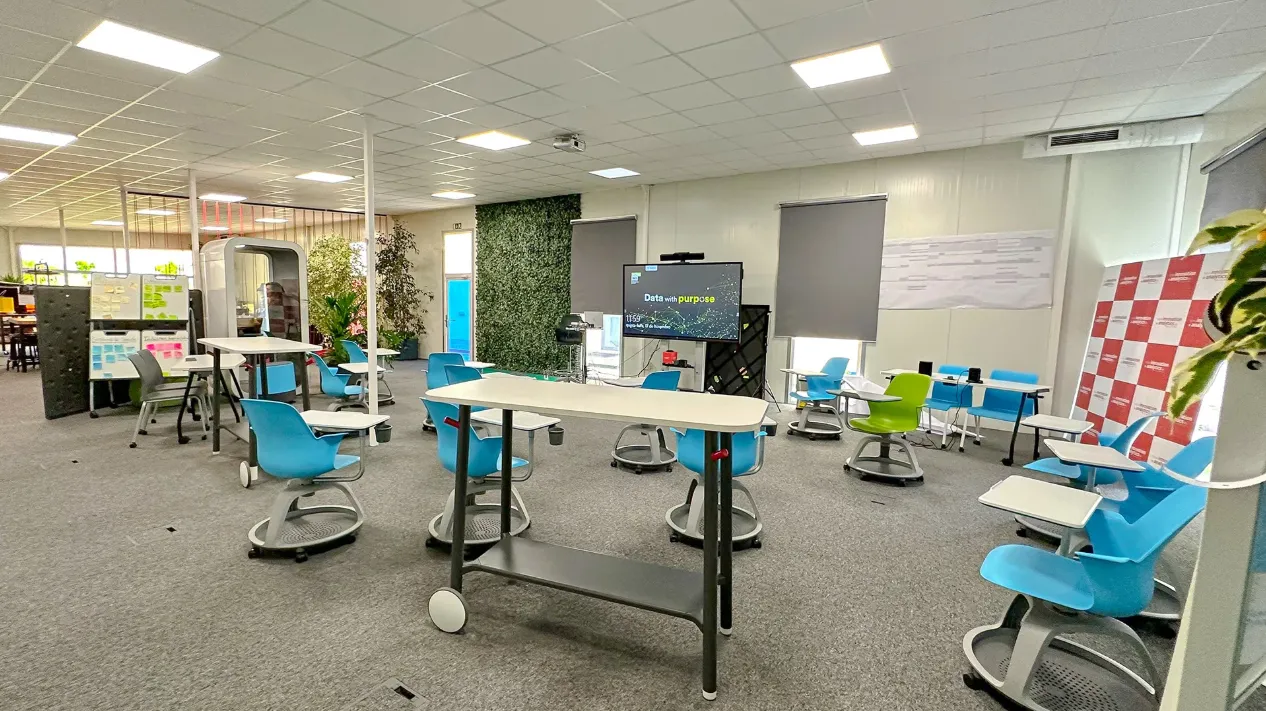 Photo: NOVA IMS Innovation Lab
Bret Victor and Seeing Spaces #
Bret Victor, a US interface designer and computer scientist, argues that traditional craftsmanship takes place in spatial environments designed for purpose — where the worker is surrounded by tools, can walk around, use their body, and think spatially. The room itself becomes a macro tool. Software tools, by contrast, are trapped in tiny rectangles (computer screens).
His vision is to create “seeing spaces” — environments entirely designed around seeing and understanding what a project is actually doing. His project Dynamic Land in Berkeley took this into the physical world: a community space where people work with real physical objects around tables, without screens. The social dynamics are transformative — everything is visible, people walk by, sit down, and start collaborating. As Victor observed, those dynamics never happen in an office filled with screens. I highly recommend his talks — this one from 2014 and this one from 2024.
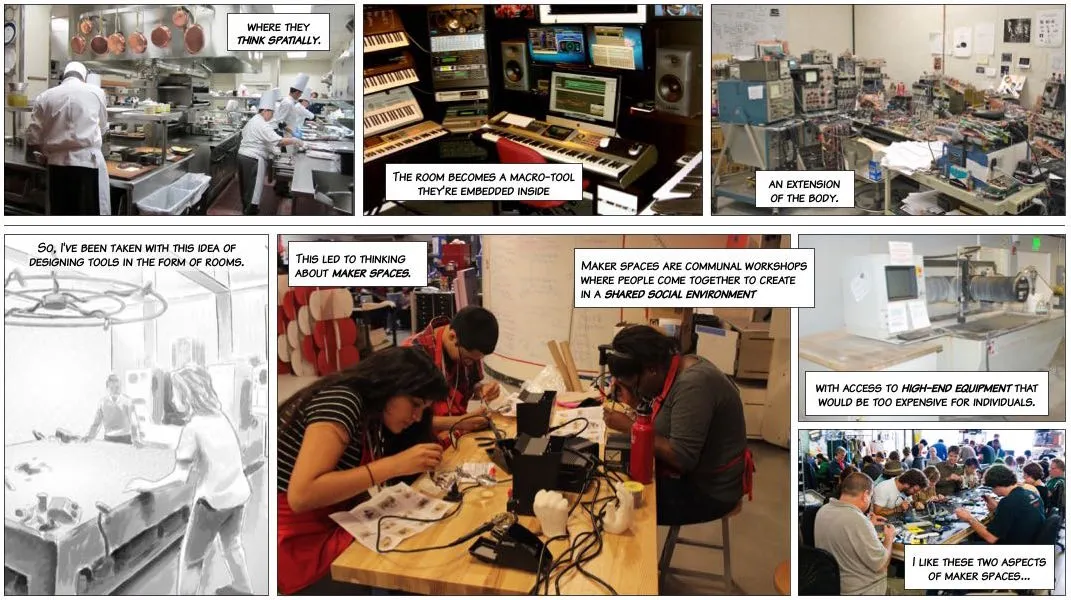 Bret Victor’s seeing spaces concept Image: Bret Victor
From Seeing Spaces to solving real problems #
During the workshop, I experienced this first-hand. Our group tackled a problem involving families — how to help them spend more meaningful time together so that children remain curious and innocent. Through the design thinking process, we arrived at an idea for a solution: an AI-driven home hub that could suggest activities tailored to a family’s interests, location, and circumstances, pulling from multiple public data sources in real time — weather forecasts, local events, live traffic, public transport schedules, and accommodation availability.
What made the idea interesting was its scalability. The same logic could apply to any destination globally. Planning a weekend trip to a city? The hub wouldn’t just suggest things to do — it would alert you if a marathon was clogging the city centre or a demonstration might disrupt your plans. Live, contextual, anticipatory — not a static travel guide but a dynamic system that surfaces and alerts you to what matters right now.
It struck me afterwards how naturally this idea emerged from the environment. We were in a room that itself pulled live data from FlightRadar to adapt its own behaviour. The space modelled the very principle our solution was built on: instrument the environment, make the invisible visible, and use that awareness to make better decisions in real time.
All this inspired me to start building a proof on concept on my homelab using n8n - a great learning project.
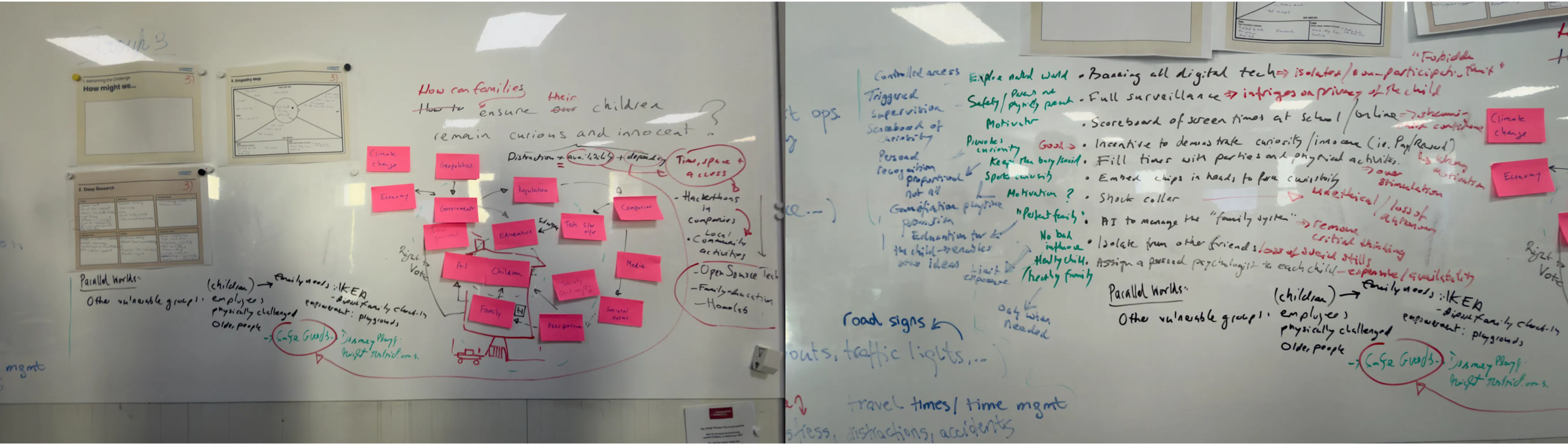 Some of the output from our team at the Lisbon workshop
Why hands matter — and why LEGO® SERIOUS PLAY® works #
Victor’s emphasis on physical materials and spatial thinking connects to something I’ve long believed: there is huge value in working with your hands. When you build something physical — manipulate objects, arrange them in space, feel their weight — you engage cognitive processes that screens cannot activate.
This is exactly why I’m a fan of LEGO® SERIOUS PLAY® (LSP) as a workshop tool. LSP is a structured facilitation methodology where participants build three-dimensional models with LEGO@ bricks to explore complex questions — strategy, identity, team dynamics, or company challenges. Its origins are fascinating. In the mid-1990s, Johan Roos and Bart Victor were professors at IMD in Lausanne, frustrated by how strategy was made — dominated by objective analysis and hard numbers, with managers’ subjective views suppressed. They set out to find a replacement for traditional strategy retreats: something with higher energy, deeper insights, and better outcomes.
When they began experimenting with LEGO® bricks as a medium for serious strategic conversation, even employees at LEGO itself didn’t see the value. Despite bowls of bricks in every meeting room and a playful company aura, few managers actually played with them during meetings. They had to more or less force LEGO’s own managers to abandon their two-dimensional presentations and use the bricks the way they invited children to use them. It took persistence — and eventually the backing of LEGO’s owner, Kjeld Kirk Kristiansen — but what many called an insane idea two decades ago is now used by thousands of practitioners worldwide. The full history is detailed in this white paper by Roos and Victor.
Roos and Victor defined serious play as activity that draws on imagination, integrates cognitive, social, and emotional dimensions, and intentionally brings the emergent benefits of play to bear on organisational challenges. The method works because it forces metaphorical, spatial, embodied thinking. People who might stay silent in a traditional meeting suddenly have something to point to, to explain, to rearrange.
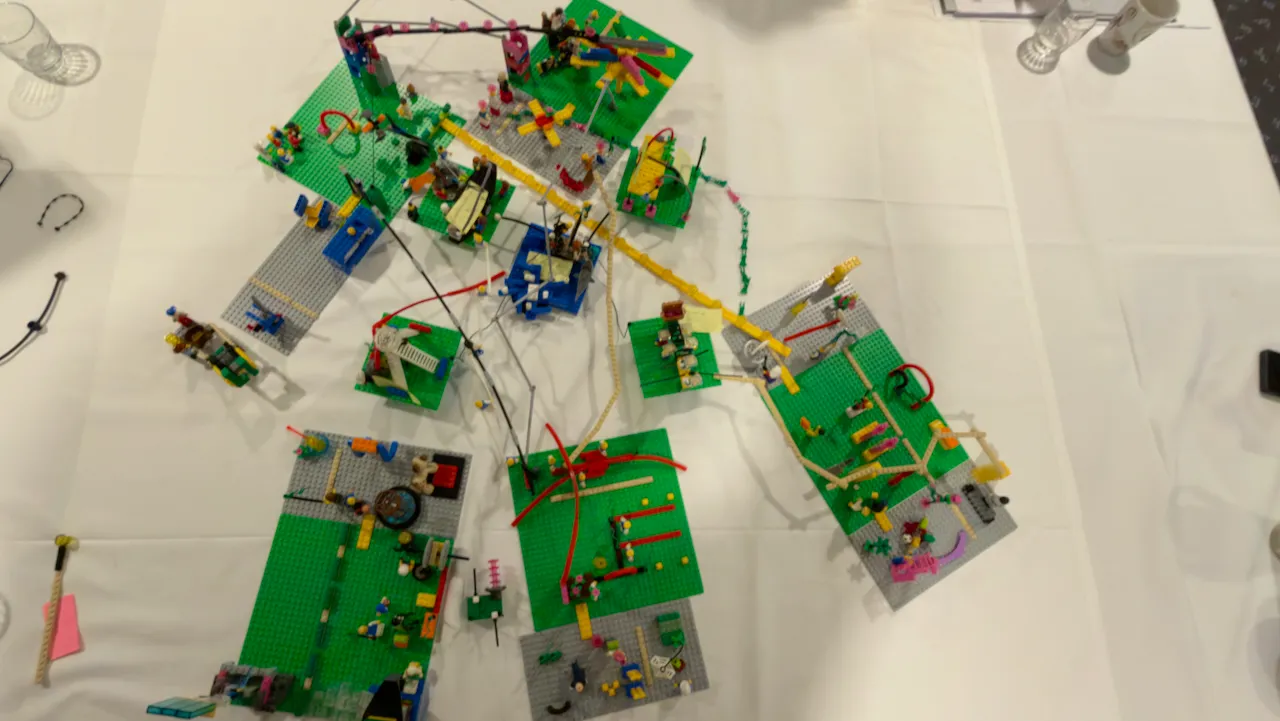 Business analysis with your hands - from a LEGO® SERIOUS PLAY® workshop
Beyond workshops: incident response and crisis rooms #
On my journey home, I thought about how this type of environment would benefit companies in ways that go far beyond ideation sessions. Consider major incidents or data breaches. When a serious cyber incident hits, companies typically scramble into a war room — which in practice means a conference room with a speakerphone, a few laptops, and people hunched over individual screens, each seeing a fragment of the picture. Critical decisions are made with incomplete situational awareness, under extreme time pressure, in a room designed for quarterly reviews.
Now imagine a purpose-built incident response space — live dashboards showing the real-time state of systems, network traffic, threat intelligence feeds, and customer impact metrics. Visual indicators that change colour as severity escalates, the way the NOVA lab’s lights warned of approaching aircraft. A room where the entire response team can see the same picture simultaneously, where the invisible is made visible, where the environment helps the team understand what is happening and what to do next. NASA doesn’t manage shuttle launches from a conference table. Why do we manage data breaches from one?
The principle extends to any high-stakes, time-critical scenario — supply chain disruptions, product outages, crisis communications. When the complexity of the problem exceeds what individuals can hold in their heads or see on their own screens, you have to build a room, because the room is the tool.
Frequently Asked Questions #
What is a “seeing space” and why does it matter for innovation? A seeing space is a concept from researcher Bret Victor describing a physical environment designed entirely around making a project’s behaviour visible and understandable. It matters because when teams can see the full picture simultaneously — rather than fragments on individual screens — they make better decisions, collaborate more naturally, and solve problems faster.
How does physical space affect workshop outcomes? Research from the SALIENT framework (Sound, Air, Light, Image, Ergonomics, Nature, Tint) shows that environmental factors directly influence creativity, engagement, and cognitive performance. Purpose-built spaces like the NOVA IMS lab in Lisbon demonstrate that when the room is designed as a tool — with live data feeds, adaptive lighting, and ergonomic furniture — participants generate deeper insights and higher-quality ideas.
Why should organisations rethink their incident response rooms? Most crisis and incident response happens in generic conference rooms with no shared situational awareness. Purpose-built response environments — with live dashboards, real-time threat feeds, and visual severity indicators — give teams the same picture simultaneously, reducing miscommunication and improving decision speed under pressure. If NASA builds dedicated rooms to manage complexity, organisations handling data breaches and cyber incidents should consider doing the same.