Why I built a conference that has no sponsors
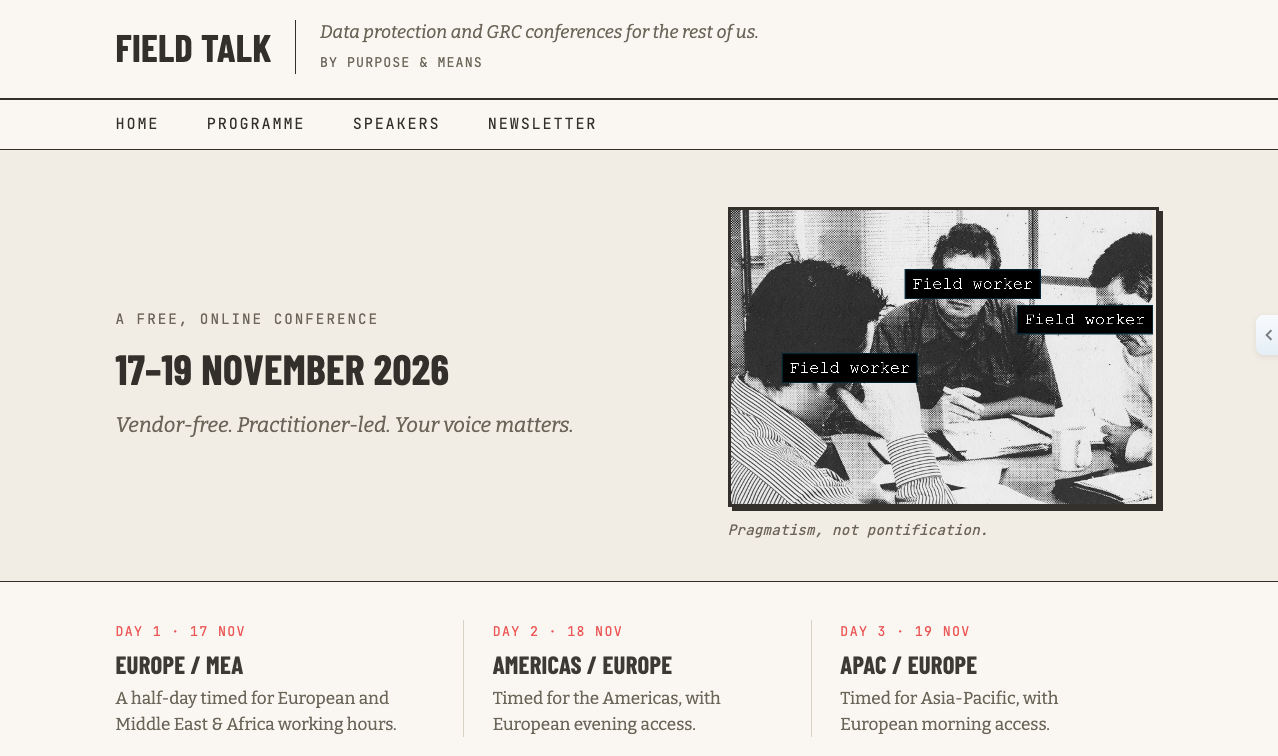
Field Talk is a free, online conference for data protection practitioners, running 17–19 November 2026. The speakers are in place, with just a few topics being finalised.
Registration opens in a few weeks. I genuinely have no idea how many people will come — and because I’m running this on my own infrastructure, that uncertainty is quite real.
I should be upfront about something. Saying “no sponsors” is not quite the whole picture. I am organising Field Talk under the Purpose and Means name, and that association has value to me. People who attend may go on to read my writing, take my courses, or hire me. So yes — this is, in part, marketing. I am the sponsor, and I benefit from running it.
The difference is scale and transparency. I am one person. There is no sales team behind me, no investor return to engineer around, no commercial partner receiving your contact details. When I say the only person who benefits from your data is me, I mean that literally: it is me, Tim, reading the list of registrants, sending the joining link, and hoping you find the sessions useful.
This post explains why I think that distinction matters.
The grassroots problem #
There are other conferences in this space that are trying to do something similar — community-led, practitioner-focused, free from the vendor circus that dominates the big events. I respect that instinct, and I share it.
But running a conference costs money. And the moment you start looking for sponsors to cover those costs, you introduce a structural problem that is very hard to manage away. Sponsors do not give money to conferences out of generosity. They do it because they want something: access to an audience, brand association, leads. That is a legitimate business interest, but it is one that sits in direct tension with the interests of the people attending the event.
When sponsors are not fully compliant #
The problem becomes harder to ignore in a data protection context specifically. Many of the companies that sponsor data protection and privacy conferences are the same companies that struggle to demonstrate their own compliance with the laws the conference is there to discuss. Their consent flows are opaque. Their cookie banners are designed to nudge. Their data sharing arrangements are buried in terms no one reads.
That is not a coincidence. It is a business model.
Bringing those companies into a space where practitioners are trying to learn, share knowledge, and raise standards is not a neutral act. It shapes the conversation. It creates obligations - implicit or explicit - toward the people paying the bills. And it asks attendees to trust an event that is, structurally, working partly on behalf of companies whose compliance record they are there to scrutinise.
That to me, is a form of manipulation. You attract people in good faith, extract their contact details, and pass those details to commercial partners. The conference becomes a lead generation mechanism dressed up as a community event.
What Field Talk does instead #
I pay for my own infrastructure. I pay for my own time. I am, in that sense, the only sponsor, but I am one person, and I am not taking a fee, so there is no financial return to engineer around.
The 15 speakers at Field Talk 2026 are speaking for free, because they want to. I am not paying them, and they are not being used as bait to fill a sponsor’s sales funnel. They are practitioners - DPOs, privacy leads, AI governance specialists, legal professionals - who have agreed to share how they actually do their jobs.
The website runs on European infrastructure. There are no cookies. There is no analytics tracking. You can check the Field Talk website and verify this yourself.
Registration opens in October. You will need to provide an email address. I will use it to send you the joining link and a reminder before the event. That is all.
Stay in touch #
I publish a fortnightly newsletter on data protection and privacy — practical, opinionated, and free. If you found this useful, you can sign up on the newsletter page.
Frequently Asked Questions #
What is Field Talk? Field Talk is a free, three-day online conference for data protection and GRC practitioners, running 17–19 November 2026. It is vendor-free and practitioner-led, organised by Purpose and Means.
Who is speaking at Field Talk 2026? Fifteen practitioners have confirmed, including DPOs from across Europe, an AI ethicist, a CISO, a barrister specialising in digital rights, and privacy leads from financial services, healthcare, and technology organisations. The full speaker list is at fieldtalk.eu/speakers.
How do I register for Field Talk? Registration opens in October 2026. You will need to provide an email address. There is no charge to attend.