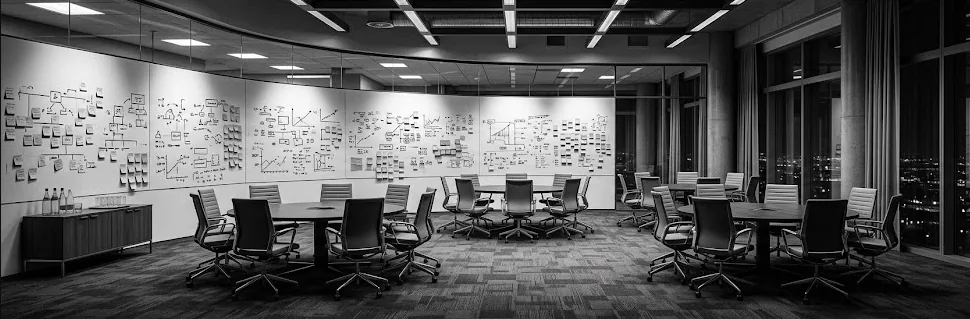
A workshop is the right format when the answer is not known yet and no one person holds it. I design the session, prepare the material, facilitate it, and produce the output. The thinking is done by the people in the room, because they are the ones who have to live with the result.
Every format runs in person or online on a digital canvas. The online version is not a compromise - for teams spread across sites, markets or entities it is usually the better option, and it leaves you with a record that does not get dismantled at the end of the day.
Something has changed, or is about to
A regulation is on the horizon, or it has already landed and the deadline is in front of you. An acquisition completes and two departments have to become one. A reorganisation redraws who owns what. Either way you need a structured view of the impact before you can plan, resource or budget for it.
You have decided to look
No deadline is forcing it. You suspect there is more bureaucracy than the work needs. Peers tell you it is not landing, or that it is too generic to mean anything. People cannot say what their role in it is. Or an audit or assessment, internal or external, has put something in writing. Someone has decided it is time to look properly.
When something has changed #
Impacts run in every direction. A new process here, a role no longer needed there, a system decommissioned, a governance board with nothing left to govern. Work that removes things is as common as work that adds them, and it is usually the harder conversation to have.
Rapid Analysis Workshop
We open with a working session on what the change actually is, and people capture impacts as they listen. Those impacts are worked through four dimensions - processes, organisation, technology and information - which stops the conversation collapsing into “legal will handle it” or “that’s an IT fix”.
The output is the first cut of a roadmap, with the deliverables that sit underneath it: detailed plans, risk, issue and assumption logs, and honest effort estimates. Enough to feed a business case where one is needed.
Half day to two daysProject and programme workshops
Once the work is defined it has to be delivered, and delivery has its own failure modes. Focused sessions on project risk, dependency mapping, planning and estimating, and lessons learned.
Aimed at the specific problem in front of the team, not at teaching a methodology.
Half dayThe Risk Pre-Mortem
Run before a significant data protection or AI project starts. The team assumes it has already failed badly and writes down why, in the past tense. Group work, with each group presenting back at the end, then a decision on what gets fixed now.
People find it far easier to explain a failure than to predict one, which is why this surfaces things a conventional risk workshop does not.
Two hours to half a dayData protection and ESG
How data protection and data governance fit with the group’s ESG commitments. Where the reporting obligations overlap, where the data behind a sustainability claim has never been examined from a privacy angle, and where a weak data protection position quietly becomes an ESG risk.
Half dayWhen you have decided to look at what you already do #
That decision is the starting point, and it is usually made by one person who has been quietly uneasy for a while.
The Fence Check
Implement an ISO standard or a framework straight out of the box, without tailoring it to the company, and you inherit controls, reports and approval steps that nothing in your business actually requires. Very few are ever removed, because removing one feels riskier than leaving it in place.
The discipline applied to each candidate before anything goes: what problem did this solve, is that problem dead, and who would notice first if it came back. A verdict on each - keep, change, remove - with the reasoning recorded, so the decision survives the next person who asks why it was made.
Half day to two daysThe Policy Bonfire
The session that surfaces the candidates in the first place. Policies, controls, reports, dead measures and processes that nobody can now explain the purpose of - collected from the people who have to comply with them rather than from the register.
It pairs with The Fence Check, which is what stops a bonfire burning something that was quietly holding the thing up.
Half dayThe Corridor Test
What the people doing the work know, and the board never hears. Short interviews with the frontline - the people entering the data, running the process, working around the system that does not quite fit. Themes are clustered and reported back.
Does the programme hold up when you walk the building and ask real questions, or only in the board pack?
One day on site, or remote over weeksThe Honest Room
Ninety minutes for the things a leadership team needs to hear. Contributions collected anonymously, read aloud without attribution or comment, clustered into themes. It ends with one committed change inside thirty days.
The commitment is the part that matters. Without it, people will not be honest a second time.
90 minutesThe Inversion Session
The team takes one compliance practice, describes how it works today, then describes the exact opposite, and looks honestly at what is better in the inverted version.
Describing the opposite is easier than criticising the original, and people will say things about the inversion they would never say about the practice they built.
Two hours to half a dayA board conversation on AI, risk and meaning
Not a briefing on the AI Act. The questions underneath it: what is this company actually prepared to be accountable for, where does it rely on a tool it cannot explain, and what would it do if that tool got something important wrong.
Senior counsel formatTwo ways of running them #
LEGO Serious Play
A method rather than a category, and it carries several of the sessions above. People build and then explain, which bypasses the rehearsed positions that surface in ordinary discussion. The results are more honest and they tend to stick.
I use it for team building, project definition and kick-off, and for making abstract risk conversations concrete enough to argue about properly.
Stakeholder workshops
Structured feedback sessions bringing together internal or external stakeholders - what is working, what is not, and what they think the direction should be.
Useful before setting a strategy, and useful after, when you need to know whether it survived contact with the people it affects.
If you are not certain which of these fits the situation in front of you, that is a normal place to start. Book a call and we will work out whether a workshop is the right answer at all.