
Déjà Vu at the Office: Why yesterday’s sourcing strategy is today’s AI survival guide
The recent wave of layoffs across major Danish companies like Nordea and Demant is a loud wake-up call that 'business as usual' is no longer a viable workforce strategy.
WORKSHOPSPROJECT MANAGEMENTITGOVERNANCE
Tim Clements
3/19/20263 min read
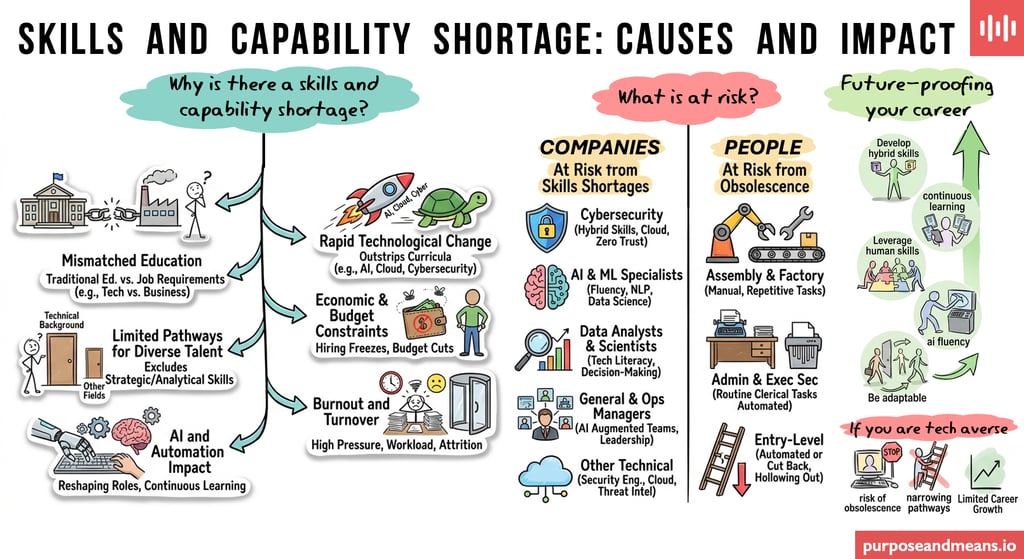
We are starting to see a huge displacement of skills.
McKinsey’s State of Organizations 2026, the LinkedIn Workplace Learning Report 2025, the ISC2 Cybersecurity Workforce Study, and the WEF’s Future of Jobs Report 2025 and also their report titled Organizational Transformation in the Age of AI: How Organizations Maximize AI’s Potential all confirm we are facing a massive capability gap that traditional hiring and training won't be able to solve.
My very high level top 3 conclusions from the reports are:
Companies need professionals who combine deep technical expertise with business acumen, and unfortunately, our education systems aren't building them fast enough (McKinsey, ISC2).
The need for "AI Fluency" - companies that fail to integrate AI into their L&D frameworks are seeing lower productivity and higher attrition among their top performers (LinkedIn).
There are many reasons why the shortage has arise and they're not all tech related (see the above infographic for a visal summary but you can hide the fact that automation is killing entry-level roles, which were once the training ground for our future leaders (WEF).
The skills shortage is not just a temporary recruiting problem. It is a fundamental redesign of the modern corporation. Companies that have realised this are moving from "hiring for potential" to "hiring for hybrid utility," and their leaders are already executing their intelligence-based transition roadmaps.
And we're beginning to see the impact reflected in our headlines. I'm based in Denmark and only recently a couple of stories have stood out:
Nordea (Finance): After cutting 271 roles in early 2026, the bank announced a further 1,500-job reduction, driven by an urgent push for AI-powered automation and efficiency.
Demant (Tech/Healthcare): The company recently reported a 700-person global layoff.
There are many others in Denmark albeit on a small scale, and globally there are similar headlines.
Reflecting on this earlier this week, I began to wonder how the companies had analysed and worked through the numbers - what roles, for example?
I realised I had been here before.
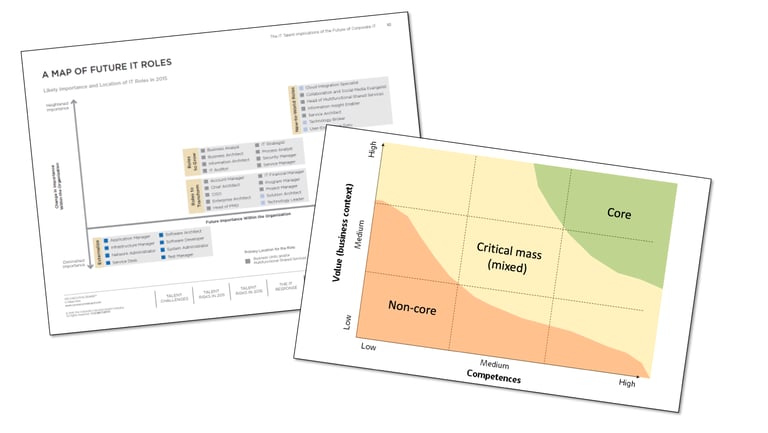
15 years ago I design and facilitated some structured workshops in a global top 3 FMCG corporation, to navigate a similar challenge during the IT outsourcing wave. We spent weeks in workshops mapping talent, defining "future states," and separating "commoditised" roles from strategic ones.
Looking back at my workshop archives, I can see that the technology has changed, but the leadership challenge has not.
Back then we were navigating critical zones - the ambiguity of which tasks belonged to the business and which belonged to an external provider. Today, we are navigating a new critical zones which is the uncertainty of which tasks remain human-centric and which can be "offloaded" to AI.
Don't panic
I have the impression that some leadership teams are currently making "fire or train" decisions based on intuition or fear, which is unfortunately a good way how you lose your best people and destroy your culture.
I use the a structured, battle-tested framework to help leadership teams navigate the critical zones so they can plan and take action. My approach is centred around these three elements:
From role-based to task-based: I suggest stop looking at titles and start mapping the specific tasks that create value versus those ready for AI augmentation.
A 4-step strategy: I facilitate the progression from "Given" (Why are we doing this?) to "Today" (What are the roles?), "How," and "Where."
The value matrix: We categorise capabilities based on strategic importance. We define what is truly "Core" to your competitive advantage and what is "Non-core."
How are you navigating this?
You don’t need more spreadsheets or generic AI advice. You need a structured, facilitated process to map your companies future in terms of skills and capabilities.
My workshop design moves your team from fear to an actionable "Map of Future Roles," ensuring your human talent is focused on the work that actually drives your business forward. If you are currently grappling with this conundrum, let’s talk.
Purpose and Means is a niche data protection and GRC consultancy based in Copenhagen and operating globally. We work with companies providing services with flexibility and a slightly different approach to the larger consultancies. We have the agility to adjust and change as your plans change. Take a look at some of our client cases to get sense of what we do.
We are experienced in working with data protection leaders and their teams in addressing troubled projects, programmes and functions. Feel free to book a call if you wish to hear more about how we can help you improve your work.
Purpose and Means
Purpose and Means believes the business world is better when companies establish trust through impeccable governance.
BaseD in Copenhagen, OPerating Globally
tc@purposeandmeans.io
© 2026. All rights reserved.