
Your data protection team protects data. Your CISO secures it. Your ESG lead counts carbon. Your data team builds AI. But who connects them?
When these functions operate in silos, you create regulatory risk, waste resources, and miss the “Governance” in ESG. The EU AI Act, CSRD reporting requirements, and evolving data sovereignty rules are converging — and they don’t respect your organisational chart. The company that treats data protection, AI governance, and ESG as separate compliance exercises will find itself answering the same questions to different regulators, with no coherent story to tell.
You don’t need a new department. You need alignment.
We help leaders bridge the gap between Data Protection, AI Governance, and ESG — finding the blind spots, aligning teams, and turning compliance into shared business value, without the bloat of a big consultancy.
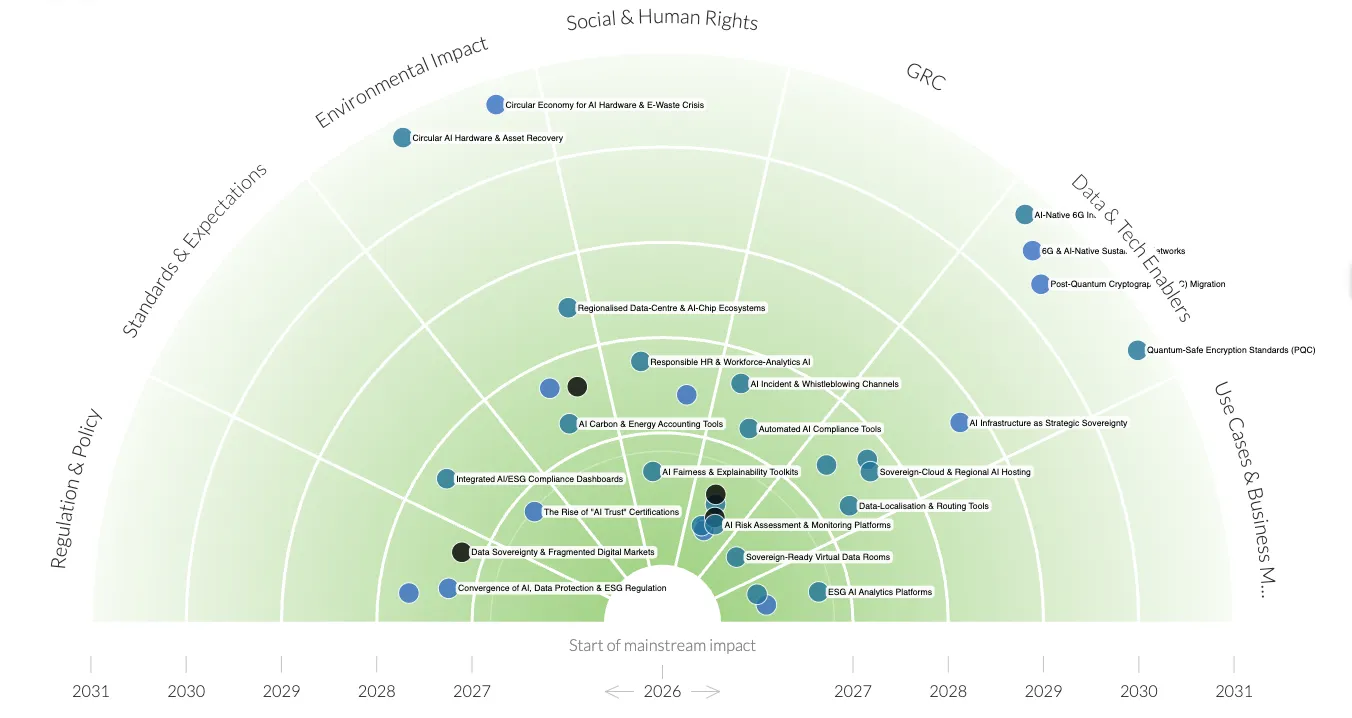
Click the image to open the live interactive radar in a new window. This content is hosted by FIBRES in Finland — by clicking you will be connecting to their servers. You can review their privacy practices in the FIBRES Privacy Policy.
Four shifts every leader must prepare for #
Based on our analysis of over 50 emerging trends, technologies, and verified market signals, there are four important shifts that every leader working in data protection, ESG, and AI governance must prepare for:
1. “Responsible AI” is no longer optional #
We are seeing a rapid shift from voluntary “AI Ethics” to mandatory Institutionalised Governance (megatrend). Soon, boards will face fiduciary liability for AI failures. The “black box” excuse will no longer hold up in court or in the annual report.
- The shift: We are moving from manual spreadsheets to Automated AI Governance Platforms. Just as you have a system of record for finance (ERP) and customers (CRM), you will need a system of record for AI.
- The action: Stop writing policy documents that no one reads. Start implementing Automated Compliance Tools and Fairness Toolkits that hard-code your values into the software pipeline.
2. The new currency is “Verified Trust” #
Our foresight analysis identified a major gap in the market that is filling fast: Standards & Expectations. It is no longer enough to say you are trustworthy. You must prove it.
- The signal: We are seeing a significant spike in the adoption of ISO 42001 in 2025. It appears that it is becoming the “badge of trust” for the AI era.
- The implication: Soon, uncertified vendors will simply be locked out of high-value supply chains (Finance, Health, Public Sector). Trust is becoming a procurement gate.
3. The “Green” strategy must include the “Digital” strategy #
We identified an interesting blind spot: the physical footprint of AI. Stakeholders are waking up to the reality that GenAI is thirsty for water and hungry for power.
- The looming crisis: By 2030, we face a massive E-Waste Crisis driven by the rapid turnover of AI chips.
- The solution: It’s time to implement AI Carbon Accounting. Developers need to see the energy cost of their code. Also, procurement needs to shift toward Circular AI Hardware - leasing and recycling compute power rather than buying and dumping it.
4. Sovereignty dictates architecture #
The idea of a “borderless cloud” is fading. Data sovereignty rules are forcing a redesign of how data flows.
- The reality: You can no longer just “put it in the cloud.” You must ask: Which cloud? Where is the data centre? Who holds the encryption keys?
- The tech response: We are seeing the rise of Sovereign Clouds and Data Routing Fabrics that automatically steer data based on jurisdiction. Architecture is becoming a geopolitical decision.
Quantum and 6G #
Looking beyond 2028, two massive technological waves will reshape the risk landscape:
- The Quantum Threat: The “Harvest now, decrypt later” risk is real. Companies dealing with long-life data must start migrating to Quantum-Safe Cryptography.
- AI-Native 6G: By 2030, networks will not just carry data, they will negotiate it. AI Interfaces will allow devices to autonomously buy connectivity and energy, creating a new machine-to-machine economy that requires strict governance.
The integrated future #
The companies that will succeed in the next decade will not just be the companies with the smartest AI. They will be the companies with the most trusted AI. They will be the companies that have successfully merged their CISO, CDO, and ESG mandates into a unified “Digital Trust” strategy.
How we can help you #
We help you align AI and data protection with your ESG goals so that your teams understand the part they need to play and the actionable steps they need to take.
- Select appropriate mapping methodology to connect data protection practices to ESG reporting requirements.
- Identify synergies between data protection, AI governance, and ESG goals — eliminating duplication and closing gaps.
- Allocate responsibilities with clear ownership across teams, so alignment doesn’t depend on informal goodwill.
- Develop meaningful metrics that link data protection and AI governance practices to measurable ESG outcomes.
- Engage employees through contextual education and training, so people understand their role in the bigger picture.
- Implement via operational procedures with triggers, monitoring, and continuous improvement built in.
Outcomes you can expect #
- A cohesive framework that aligns data protection and AI governance with your ESG goals.
- Clear metrics that demonstrate the connection between data practices and ESG outcomes to leadership and stakeholders.
- Educated and empowered employees who understand how to make the right decisions in their daily work.
- Enhanced trust with stakeholders through transparency and accountability.
Want to get started? #
If your data protection, AI governance, and ESG efforts are running in parallel but not connected — book a call to discuss how to bring them together into a coherent strategy.
Frequently Asked Questions #
Why should data protection be part of our ESG strategy? #
Data protection is fundamentally about how organisations treat people — their employees, customers, and communities. That places it squarely within the “Social” and “Governance” pillars of ESG. Companies that handle personal data ethically and transparently score higher on stakeholder trust, face fewer regulatory actions, and are better positioned for ESG reporting requirements like CSRD. Treating data protection as separate from ESG means missing a significant part of your governance story.
How do AI governance and ESG connect? #
AI systems consume significant energy and water resources (environmental impact), can produce biased or unfair outcomes affecting individuals and communities (social impact), and require robust oversight structures to manage risk and accountability (governance). As AI adoption accelerates, regulators and stakeholders increasingly expect companies to account for these impacts within their ESG reporting — not as a separate compliance exercise.
We already have separate teams for data protection, security, and ESG. What does alignment actually look like? #
Alignment doesn’t mean merging teams or creating a new department. It means establishing shared frameworks, common metrics, and clear communication channels so that these functions work toward coherent goals rather than duplicating effort or creating gaps. In practice, this might look like joint risk assessments, shared reporting dashboards, coordinated stakeholder communications, and cross-functional governance structures.
How do you stay current on the trends covered in the foresight radar? #
We maintain our radar using FIBRES, a Finnish foresight platform, and continuously monitor over 50 emerging trends, technologies, regulatory developments, and verified market signals. The radar is updated regularly and is available to clients as an interactive, navigable tool — not a static report that goes stale.